fića
(Machine, Yugoslavia)
It was a car. Based on FIAT 600, with a souped up 750 ccm engine. It carried four people, provided they weren't too fat. The working man's car. I learned to drive on one, and would sometimes get a chance to drive one - never owned one, though. Sat in many of them while hitchhiking. Dad owned one, 1967-71, and it went as far as Warsaw and Black sea, plus the numerous smuggling trips to Romania.
Production ceased around 1981.
The main line in instruction manual (unofficial) was „step on it, you can't overdo it“.
Dad had one, 1967-1971, drove it all the way to Warszawa and Black sea. Smuggled a hill of stuff. His was the older model, with hinges on the doors in the back, and handles in the front, opposite from the standard. If the lock gives at any decent speed, the air drags the door out and slams it over the rear window. Don't know if that ever happened. The standard and common logic dictate that the hinges be in front. And they did put them so, a few years later.
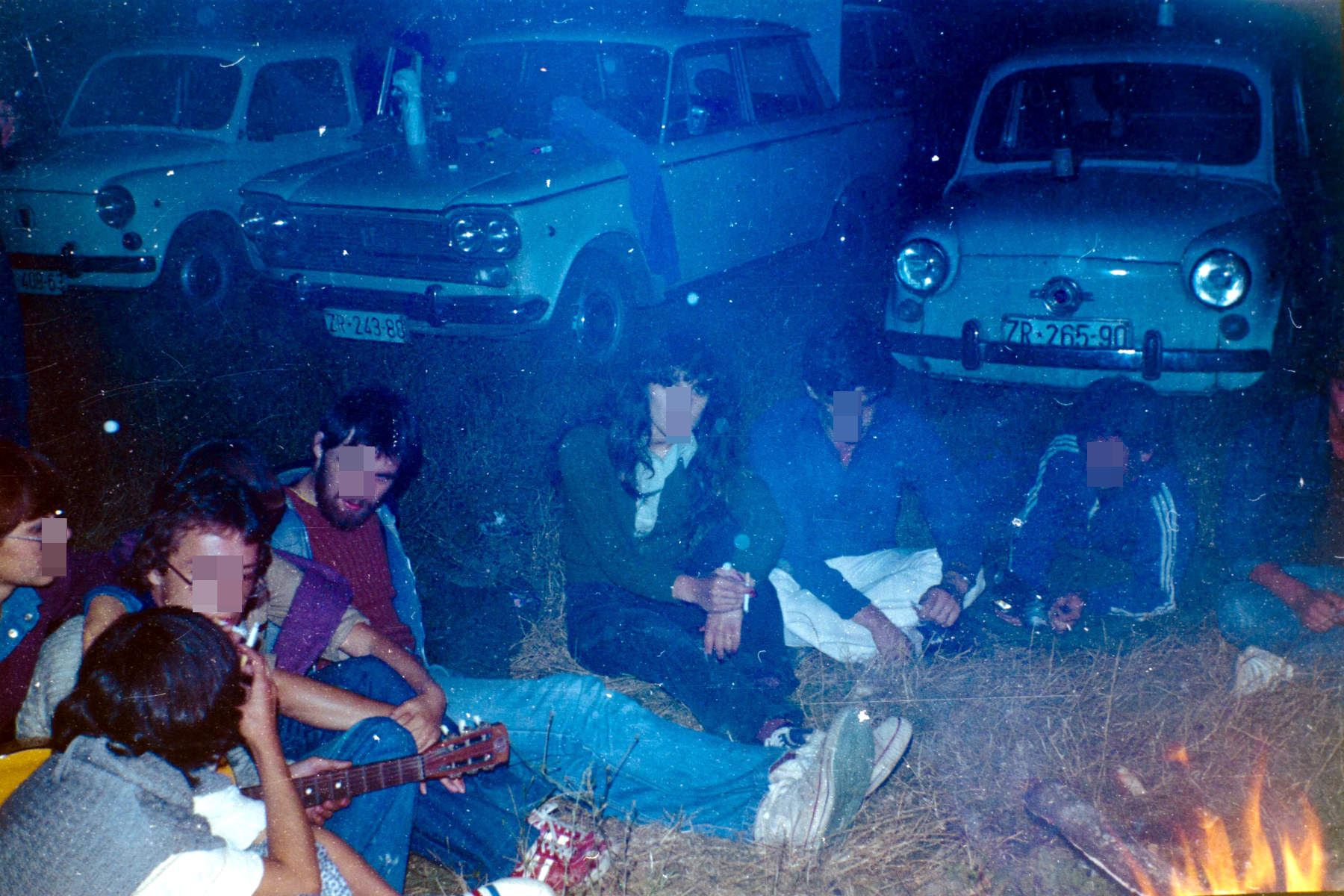
I'm adding this picture here just to show how Crvena Zastava never managed to make their own presses, so they used italian, unchanged. Look at the license plates. They don't fit, there's no room there, it's about 2-3 cm tucked behind the fender. That's because the italian plates were different - the front one was much smaller, at least by half, and there was a space where it fit exactly. In the rear, there was also a difference, their rear plate was to hold two rows of text, so it was also narrower than ours by about a third, and twice as tall. The rear plate light was designed to shine on that and it never gave enough light to read our plates.
What Zastava did change was the headlights, a bit bigger now than on the model of the sixties, and the plastic ornament on the front, which was now smaller and simpler. It was still too big for the front plate to be wholly visible.
Of the known folks, owners of these were Arpi, Ilona, priest Laza (dad's accountant in the cooperative back in about 1956... and a dark blue, police color, so everyone got out of his way and he passed whomever he wanted), Dimče (until he bought the inky Escort), Bakračevi and at least two more houses in the neighborhood.
May as well put that here, out of dozen equally fitting places, of what equipment the cars lacked then and how and when each piece became normal. Fića was a minimalist car, lacked lots of stuff, of course lacking what everyone else did.
For ventillation it had butterfly windows (small triangular window in the front part of the door, which swiveled around an axle, defined by hinges above and below), which škodilak also had, though it had a luxury version, not locked by a bolt and operated by pushing out, it had its own lever that you turned. Almost all of Fiat and Zastava's vehicles had them, guess the yugo was the first one without and the fan became a standard. The good side of the butterfly window is that you can turn it out more than 90° and it quickly replaces the inside air at even the worst swelter, at speeds of above 30. The bad side is that any semiliterate burglar can open it from the outside. The AC in the car was long considered an unimaginable luxury, not even the fregata had it, despite being a rather posh car for the time. The first AC I had in the US, then in Joda - even saxo didn't have it.
Fića had no reverse drive light (and trabant, kafeni, spaček likewise didn't; škodilak did but these were weak; tristać had one - the hole on the other side was taken by the tank stopper; soon the Moskvič came with something shining well). The Stojadin didn't have it in basic version, only later as an add-on.
Only the džegers (guys who wanted to be bigger frajers) put the foglights (v. june 1972., forelast photo), perhaps some field workers. I never had them until they came with the car (Matrix, van, Joda).
Fića had no outside rear view mirrors. These were sold on aftermarket. Don't remember whether dad bought it for fića or for the first škodilak, I think the second one had it already. The right outside rear view mirror was still a rarity, until it started coming as standard in, guess, eighties. Of the two exemplars on the picture above, as far as I can discern, there are none, and this was as late as 1976. On the shot for 05-X-1971. I see that the tristać had it, left side only, but not on the door, the butterfly window would be in the way, it's ahead of the windshield, and rather small. I can't see what use was it, so far and so small, how much did it show anyway.
Choke. Fića had a manual one, which one had to use whenever it was anywhere near cold, and not for long, because the tiny engine would warm up quickly. The škodilak had some kind of automatic choke, with thermostat measuring too close to the exhaust, so it'd switch off too early, while the engine was still cold. Starting it in winter was screwy, as soon as the engine responds, had to step lightly on the gas and keep it so for a minute or two. The next model had a manual one, just like all the cars had until the eighties or so, when the problem was largely solved, all later cars had it automatic, even the manuals stopped mentioning the word.
A weird sequence occurred with windshield wipers. Fića had one speed, trabant two, the first škodilak two, the second had two regular and four interval, to cover everything between light drizzle and still no need to switch to continouos. Corolla had two and an adjustable interval, and then the Matrix, as a posher and stronger sibling on the same chassis, didn't, had just one interval. Then all the way to Joda, which has a sensor and decides when and how often to wipe. The third wiper was needed for anything with odd number of doors, so even yugo had it - but kafeni didn't.
The rear window heater was sold as a sticker, and I saw a lot of those in the seventies and eighties. In the nineties, even the yugo had it as standard, because its heating would never reach back there.
Radio existed in Opel's models, I remember I played with the buttons when čiča Rada would come in the Olympia. Perhaps the tristać had it. Ours didn't manufacture much of car radios, these were mostly smuggled or bought in a komision. They'd be installed by various guys, everyone knew one who knew how to put it in. The highest skill needed was to drill a hole for the antenna without damaging the surface too much. Many a fića got a radio, and the hole was, as a rule, beneath the lower right corner of the windshield. Then the next problem was the electric noise from the spark plugs, which was solved with new cables, something with higher resistance, so the current was weak while still giving a good spark. In a few years, by mid-eighties, everybody had such cables, except the mopeds, which screwed numerous attempts to record music from the radio. Those little farts had about hundred meters of range.
The first car which came with some systemic support was the yugo - it had wires in the doors and to the rear shelf where the speakers go. Though, when I was putting that together, I didn't quite get the wiring so I fried the right channel... For kafeni and trabant I bought something on the flea market, connected it eyeballingly and it worked, can't say it didn't.
The tachometer (RPM... tahometar here is the piece which draws a graph of speeds over time, for the trucks) was something only sports cars had (and motorbikes!), but fića also if it was abarthed. The car shop Abarth in Trieste was famous here for boosting up fićas to incredulity, just watch the „National class“ movie. We saw the abarthed around town, or knockoffs, there were always guys who'd boost their wheels. The least they could do was to drill a few holes in the moped's exhaust to make bigger noise. The tachometer as a regular piece of equipment I saw since 2000 (having driven dad's clungers until then). I think the fregata had it.
Power steering was another unimaginable luxury. I once drove a mečka (lady bear, i.e. a merc) with it, when that couple from Slovenia were guests here, and I was the designated driver. I understood immediately what it was, luckily in a mild curve. By the nineties it started coming standard, even saxo had it.
Ashtrays. Fića had one, sized about as a paycard, which would fit no more than five cigarette butts. And it was in an unwieldy place, beneath the middle of the windshield. It was hard to take it out to empty it, so mom bought somewhere a brass one, even smaller, which hooked by a magnet to a spot in front of her. That was possible, because in a fića there was a lot of space where the metal wasn't covered. The škodilaks were a great leap forward, the ashtrays were hefty, easy to pull and also take out. About trabant and kafeni I don't remember, guess I would if there was a problem. There was one in the corolla, because the previous owner simply discarded the ashtray and left a hole, which I solved with beer cans, just like I later did in the Matrix, saxo and the van. saxo did have an ashtray, but it was too low and in front of the shift stick, unusable. In the Joda there is one but not instilled, it's a cute can with a lid, which fits in the beer holder. I'm not using it, it's top is too small to locate while driving, but we rather use the plastic one from detelina, which I can locate without looking.
Seats... Fića and yugo are rather uncomfortable, trabant much better, and them having two doors, the front seats either go up whole, or their backrests fold down. The kafeni was the first one with really comfortable seats, despite of them being thin upholstery strewn over rubber bands spanned on steel tube frames. The škodilaks are a story to themselves. Even the oldest model, the 1000MB, such as Janči had, had seats with backrests which could be bent back to horizontal, and with the front seats pushed all the way forward and the rear seat being propped up a little, it turned into a real bedroom. Bukac recounted how his neighbor, a hooker, bought one for that feature alone, to use as a workplace. And true that, it could be used that way. I never tried to sleep in the Toyotas, but did in saxo and Joda, sitting though, the backrest bends backwards just enough.
Mentions: march 1961., march 1967., 15-VI-1967., august 1967., Vacation, caravan way, 28-VIII-1967., december 1967., april 1968., 19-V-1968., 02-VI-1968., 04-VII-1968., 14-VII-1968., 15-VII-1968., 20-VII-1968., 11-VIII-1968., 08-II-1969., 16-IV-1969., 22-IV-1969., 11-V-1969., 18-V-1969., 25-VI-1969., 03-VII-1969., august 1969., 07-VI-1970., 07-VII-1970., or thereabouts, 01-XII-1970., until 17th, 01-VII-1971., 21-VII-1971., and the rest of those days., august 1971., 01-VIII-1971., 17-VIII-1971., 05-X-1971., 02-XI-1971., february 1972., Photos, 27-V-1972., june 1972., 08-X-1972., 19-VIII-1973., 23-VIII-1973., 13-I-1974., Korni grupa only tonight, july 1974., august 1974., Vacation enforcement, 23-V-1975., 22-VII-1976., 30-VII-1976., 26-VIII-1976., february 1977., 23-VIII-1977., 31-XII-1977., 21-V-1982., 20-I-1989., Interest, as per bank, 06-VI-1994., 29-XII-1995., december 1996., 01-VIII-2005., 12-XII-2009., 27-XII-2010., 05-VII-2014., 21-II-2016., 17-I-2017., 13-VIII-2018., Man, the van, 26-V-2021., 07-VI-2021., 14-IV-2024., 14-V-2025., Arpad Gunaroši (Arpi), auntie Janja, Bakračevi, detelina, Dimitrije Josin (Dimče), frajer, fregata, Gradivoj Buković (Bukac), Ilona Gnajs, Janči Gnajs, Joda, kafeni, Radomir Sredljević (čiča Rada), saxo, spaček, škodilak, trabant, tristać, yugo, Zajač, in serbian
26-V-2007 - 24-VIII-2026