february 1972.: Photos
Buzzing all over downtown this month - the conference, and shooting the „Can not“ - I carried regula as well quite often, and kept shooting whatever piques my interest. Turns out I have quite an overview of what downtown looked like at the time.
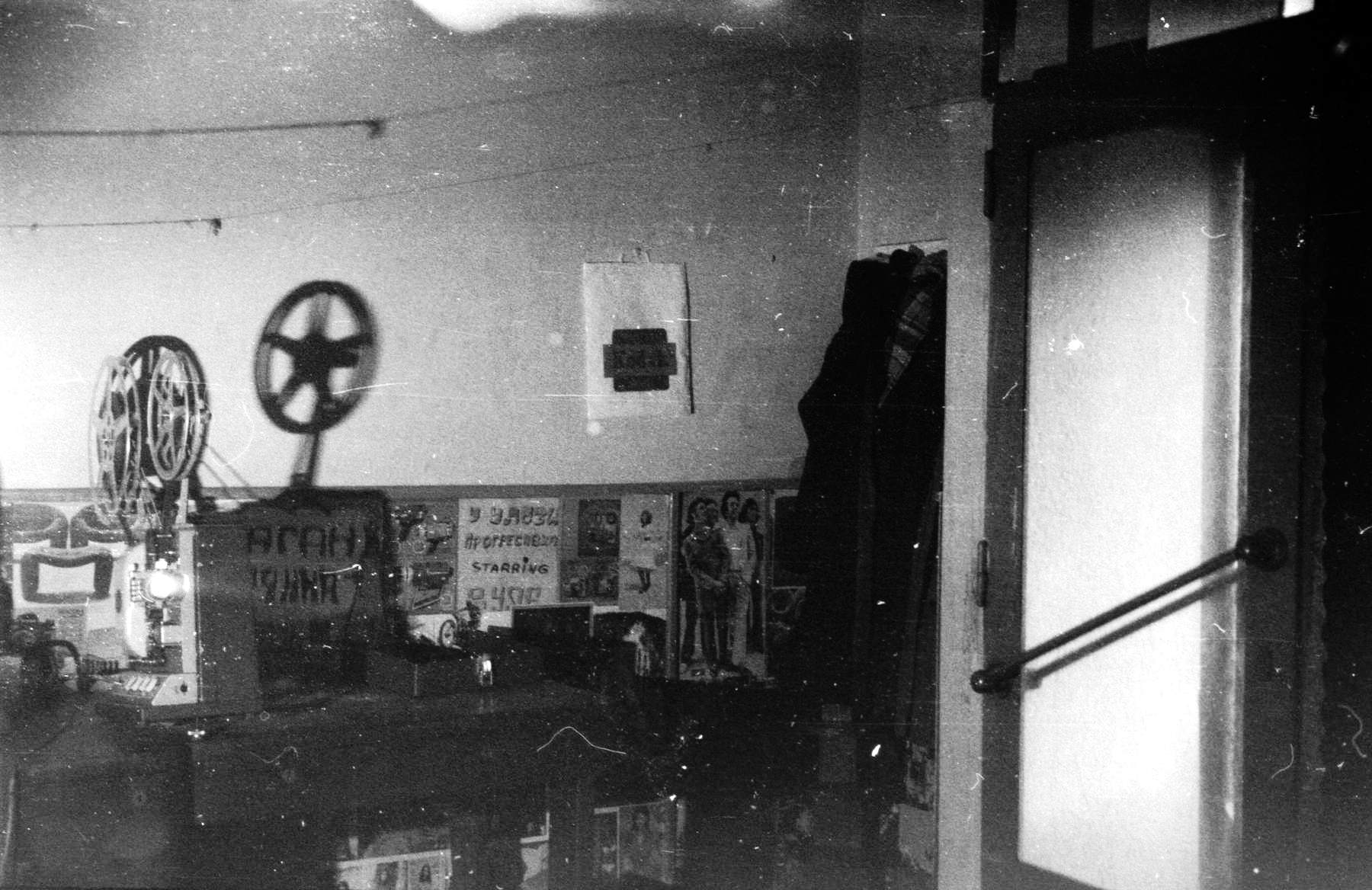
This was shot in DC-99 when we were training the others from the club to operate that 16mm projector from the militia. I mastered it last year, when we were making that half an hour documentary. It's nothing complicated, justt bigger and stronger, specially the lamp is stronger, it takes more light for a larger screen, and the surface of the film frame which it shines through is about four times more than that of the eight. So the first instruction for use is „if it stops, turn off the lamp“, because it burns through the tape in a second. With eight, there's at least seven seconds before the burnout.
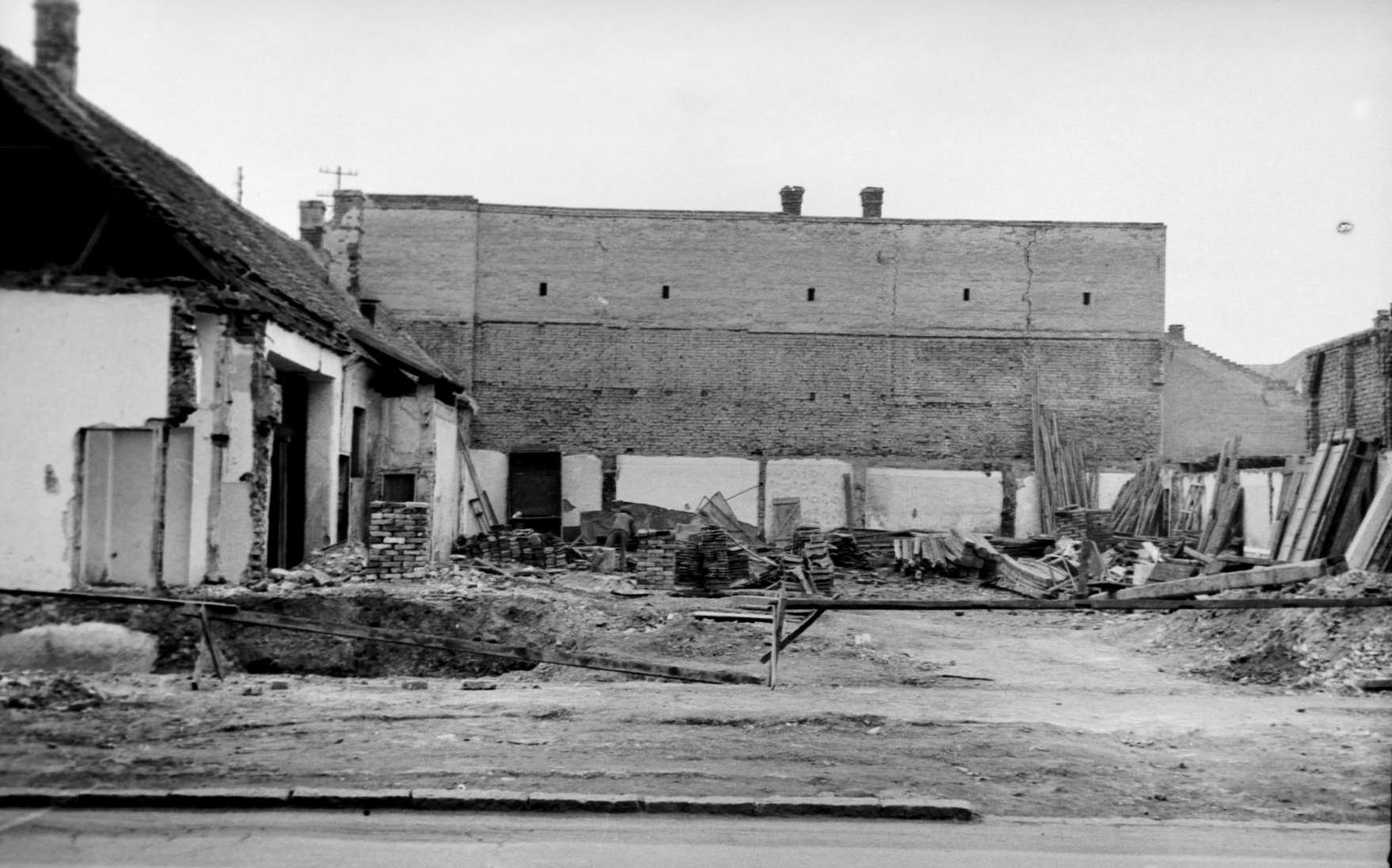
As I'm approaching the Žitni square, I pass through the ruins, the site of the future novogradnja is being cleared for the construction, which will run the whole southern edge of the square, plus a bit more, almost to the brewery, so actually longer than that side of the square. This will be the entrance to the rear parking behind that building, which we'll later (around 1975 or six, I guess) call „pride“*. I was standing at the same spot on 10-V-1970., well even once before that when there was some kids' karneval, of which I remember in much more detail the house across, next on the right beyond the edge of this scene, where a bicycle repair shop was, specially because it was raised high, the floor was at least a meter above ground, wit a hundred tidbits hung inside, even oodles of it outside on the door, guess it was an advertisement. They're selling yarn there now, I guess.
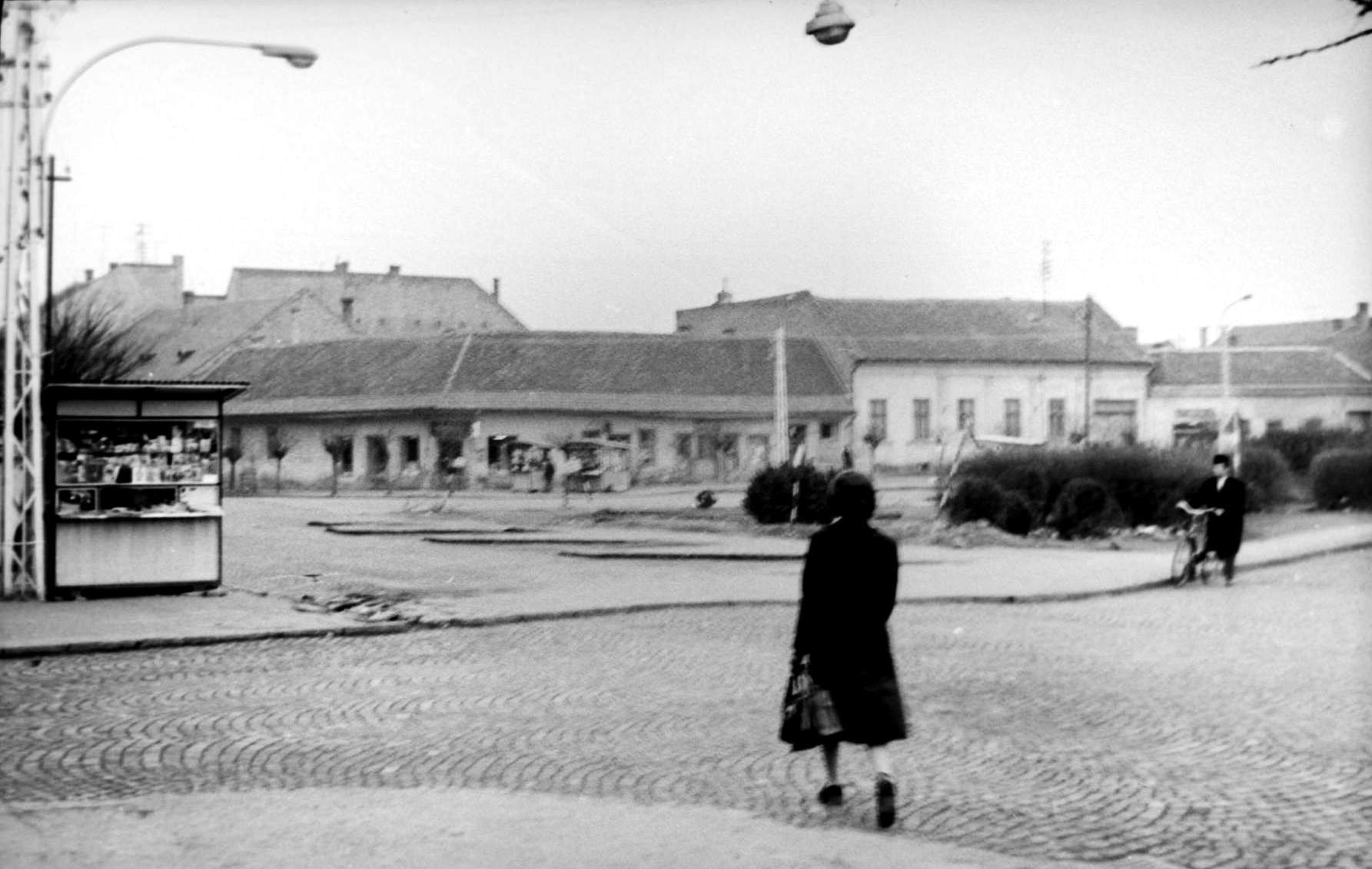
The Žitni square (wheat market; once called Old Žitni, and nobody remembers that the New Žitni was in front of today's Lesnina). The zig zag curb is actually bus concourses, this was where the interplace buses station was, those to nearby villages. The rumpled sidewalk in front of the kiosk stems from many bus drivers being loathe to maneuver backwards to exit and taking a shortcut over it. The intercity [station] was a corner away, with likewise zigzag curb. All the buses used those two stations, except Lasta's [swallow]. Lasta had its own bus station, some 300m further beyond the scene, in the direction of this road that goes diagonally across the square to Temišvar (Timişoara) (and the belgrade road would enter by the other diagonal from the right, and they intersected right in the center of the square. True, this half of the square was a dead end now, what with Eiffel's bridge being dismantled and replaced with the pedestrian one, and the new bridge by SUP [secretariat of interior, aka police aka militia] being built before that.
And the bussers weren't the only ones with their own retail, here the kiosk belongs to Politika (the distinct model they sported, and they had more of the same - in the main street, by Šanta**, on 25. maj that I remember). Their own network of kiosks had also Borba, and Novostti, and the rest belonged to Presprom (or whatever they were called then), and even Mađar So (Magyar Szó) had a few. Numerous factories of footwear and garments had their own retail networks - of shoes, in main street there was Borovo, Solid of Subotica, Proleter (of Belgrade?), and soon three from Slovenia would come, Peko, Planika and Alpina.
Note the many poles with light, that's the mercury lamps, one is even hung over the middle of the intersection, on the wire spanning diagonally from corner to corner, but they never sufficed. The sidewalks, specially in this stretch where the demolition and then construction commenced, were made of concrete tiles of 25x25cm, which are rather disheveled here, and even further down the street the soil beneath them wasn't tamped properly, so they'd rock when it washed away under a corner, so if one steps on it, the water just jets up to one's knee or higher. In other places some parts, where the soil sank, would create puddles, and the light at night was enough just to see that there's a terrain ahead in two shades of gray, but one never knew which one of them was a puddle and which was concrete.
The old house in the center was a paint shop, where I was frequently visiting in the following years, when my room was done. Their main item was the so-called štricla, an earth paint powder, which was laid in topless partitions in the shelf behind the counter, and was sold by the kilo and packed into pak paper bags. The pak paper was made in two colors - ordinary pulp color and some dark blue, pretty much the worker's smock shade, sold by the bolt or by tabak [sheet, word probably unrelated to tobacco], and was frequently used to pack what was sold, as very few items in retail came in their own packaging. In merchants' school they learned packing and tying the twine into a proper knot. The twine was bad, but the three-colored tape, same as for jemstvenik***, where the loop, which they'd tie to hold the shoebox by, would cut into your palm by the time you brought it home.
Various shops paraded through that house later. One „Modus“ lasted the longest, with a good assortment of metražna [by the yard, ahem, meter] goods and ready garments, where we often bought some, and then the eternal banana-yellow façade was replaced with mouse fart graphite gray, windows covered with foil, when a gambling joint, aka bet shop, moved in. The house as good as vanished, there's no shop window, nothing there for normal folks, it's for those who know why they go in. Why do they darken the windows? My theory is that those inside don't want to be seen by anyone except the fellow sufferers.
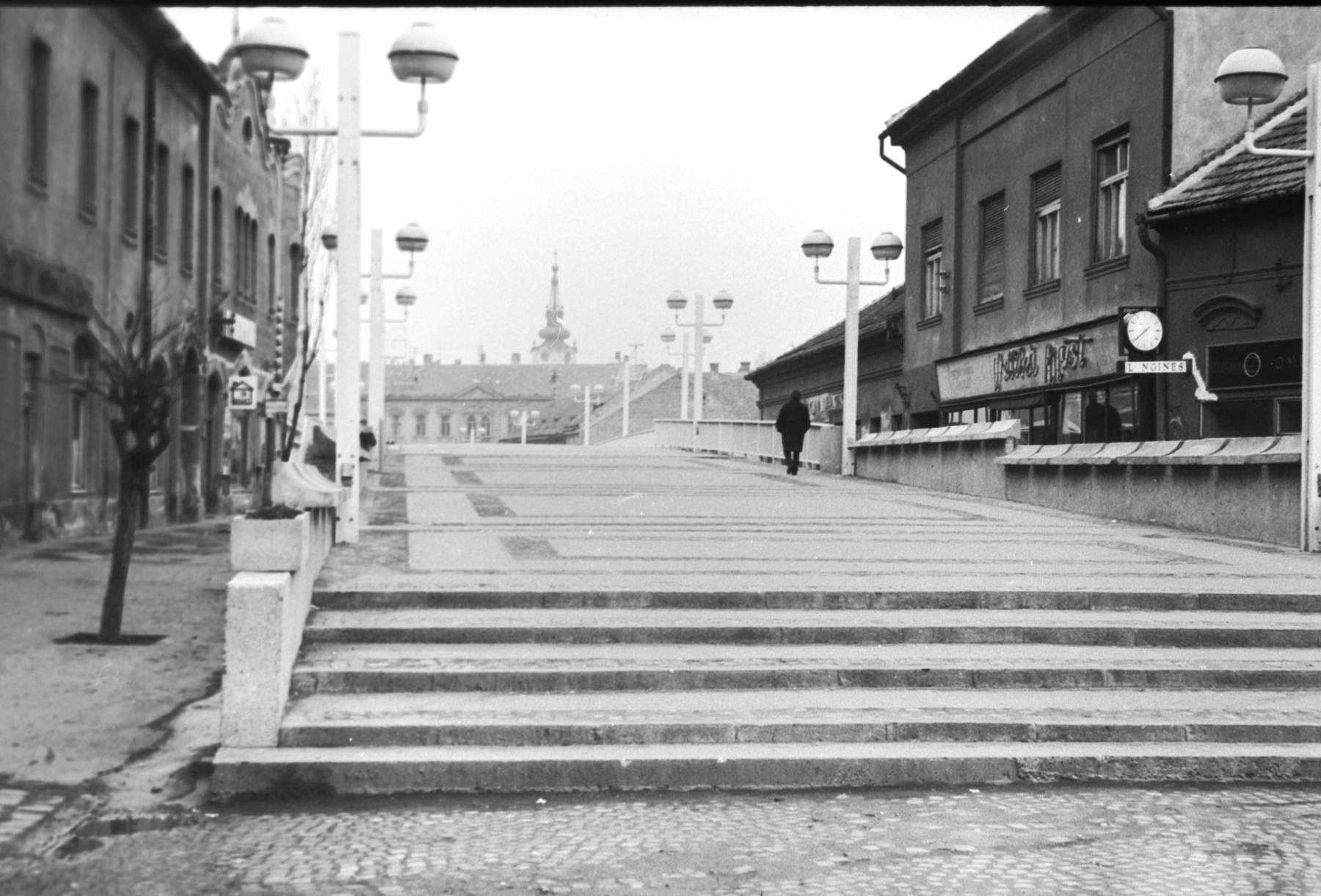
And here's that pedestrian bridge, just a year after being put in place, and it already had to be resurfaced. Those squares were some white tiles and bare concrete elsewhere, but the tiles got loose with incredible speed, so instead of them they inserted these granite cubes, same kind as the pavement on the access to the bridge. Those cubes will hold for some twenty years, and then on the other side of the bridge a big bank building will sprout, and the whole square in front of it will be raised almost to the height of the bridge itself, to gain the space below for more business space, and in the same move the access to the bridge will be covered with granite plates at least from that side, and the ridiculous staircase spaced one and a half steps per riser (where nobody ever managed to catch a rhythm, that's oddball as such) was replaced with a nicer [one], spaced one and a half steps per riser [wrote „steps per step“ first, but good people of burundi helped me with that, where every now and then a plate would loosen, so it was done anew every few years, and as of 2024 I still don't know whether the underground space is still dripping rainwater.
The fences, both concrete and iron, are still holding, as are the lampposts. The lights themselves were replaced with leds only around 2018.
On the left, in order: the agr. cooperative (yes, the city had its peasants with fields around the city, and they had a cooperative), the tavern Mostar aka Najlon (nylon), of bad repute, it was a tavern for dert and karasevdah [special oriental-like state of mind, when suffering a bad luck in love and taking it out on any glassware, musicians and tavern inventory, to the last dime; blues, in other words] and stuffing hundreds of dinars into the singer's cleavage or lower. Then Bagat's shop, where mom came often, not so much to fix the sewing machine, it didn't break, but rather to get various accessories and the fabled gaskets for pressure cookers, if they had the exact model and size. And finally, last shop to the river, [movie] theatre „Vojvodina“ (where you couldn't understand a word in domestic movies), which ran mostly the popular genres - cowboys, Old Šeterhend (shatterhand), later kung-fu, Godzilla and less popular titles, including artsier Fest movies and domestic re-runs. In the lobby there was the ticketing and some cakeshop, a Macedonian or Goranac. The waiting room, where you wait for the previous projection to end and to be let in to take your seat, was facing Begej from a considerable height. Smoking there was allowed, in the audience not.
[To the] right [there] was Omikron, a classical clock repair shop, where we'd take this or that clock to be cleaned, and a couple of times to be fixed. There was „Fruška gora“ with shoes, „Great bridge“ with probably clothing, and eventually „Gvožđar“ (the ironworks guy) of Čelik, where I was often a customer some ten years later.
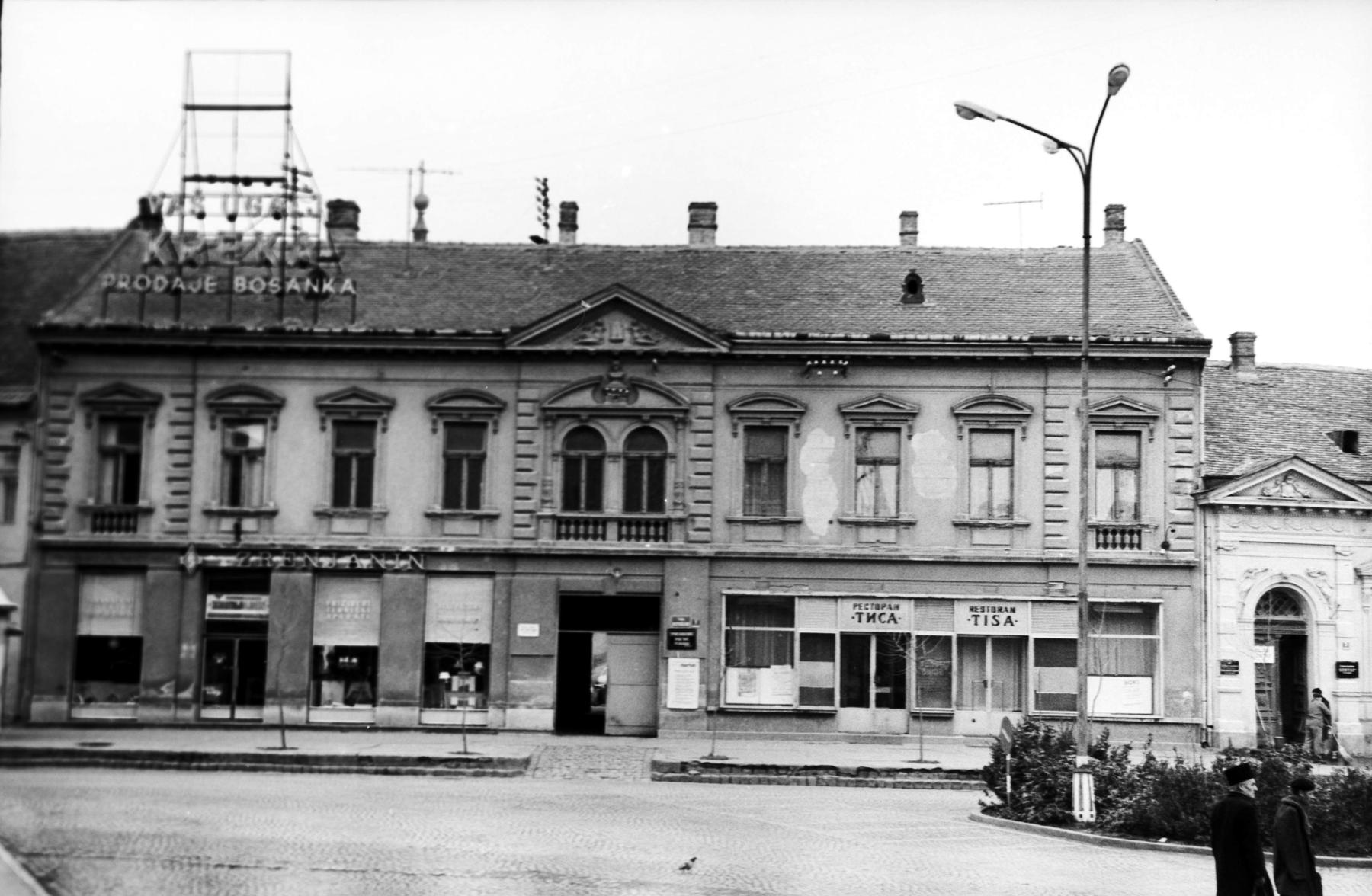
This square, the other side of the bridge, once was called Vilzonov trg (Wilson's, guess the wood row), no idea what was it called this time, with this bit of park on the median. The old building across holds in the left wing another shop by Čelik, this time appliances and electrics (lamps, fridges, television sets) and to the righa another smash-bottle tavern, „Tisa“. It never looked attractive to me, I don't like the places where your head may accidentally become the place where a launched bottle lands. The plate above one door is in cyrillic, other in latinic, but it doesn't help you guess which door actually works. They never open all the doors.
The ad on the roof („Your coal Kreka sells Bosanka“) is at least ten years old, and bears the feel of how still naive was it back then... why would anyone sell our coal, and to whom is this Bosanka [a bosnian woman] selling it?
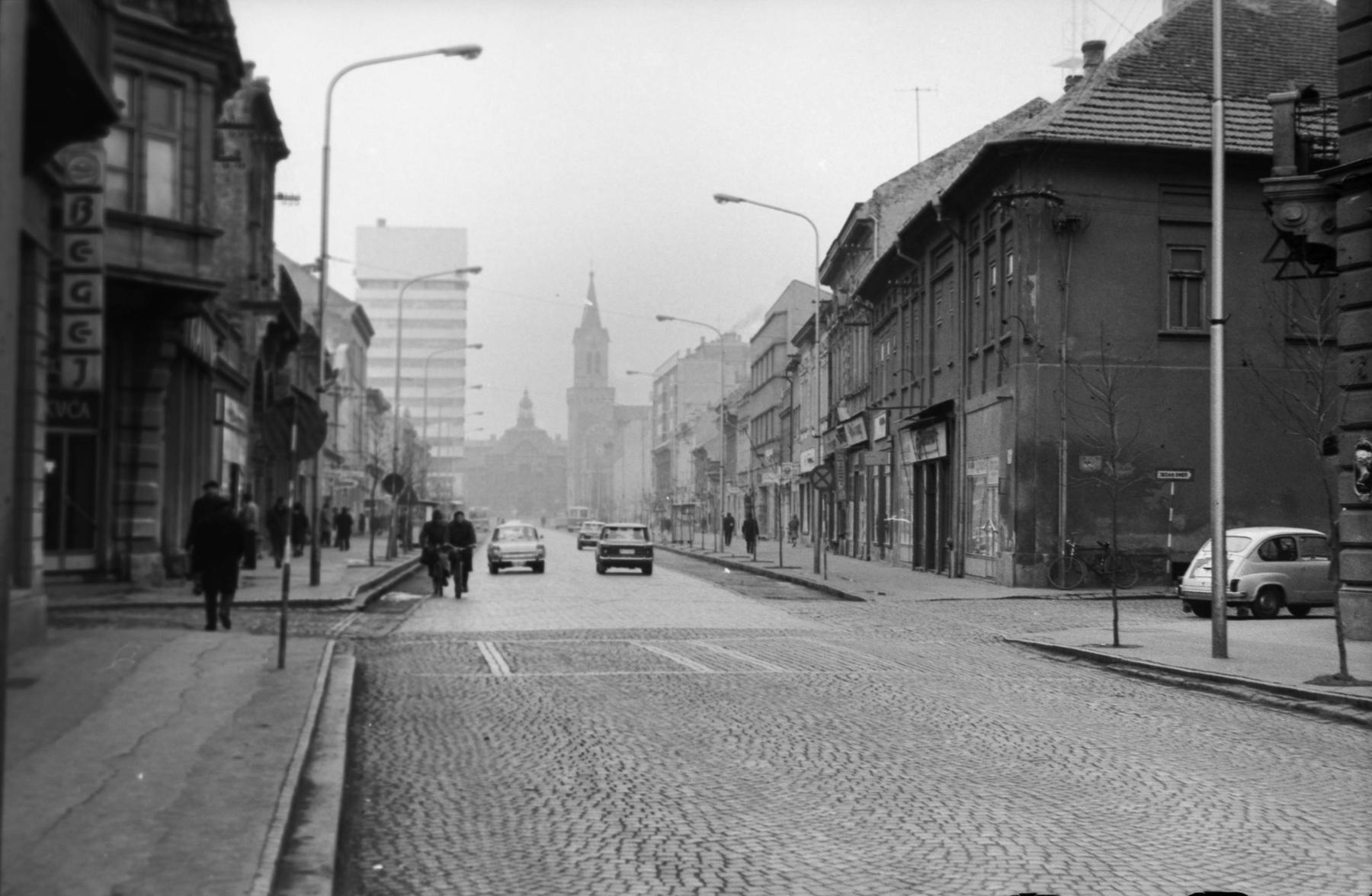
Thirty meters further left from that this view up the main street extends. Had I had any color material, to show how the light stripe of pavement in the middle is actually the yellow brick, fuckingly slipper as soon as a bit wet, and the granite cubes in the closer part by the pharmacy ain't much better. The „Begej“ [on the] left is hats shop, and [on the] right are, in order, the cakeshop „Sport“, then again a hats shop (or something else then, before the hats moved there), then Prleski. Of cars, all known - a škodilak 1000 MB, a tristać, a fića on the right. In the yonder, of course, vodotoranj and city hall.
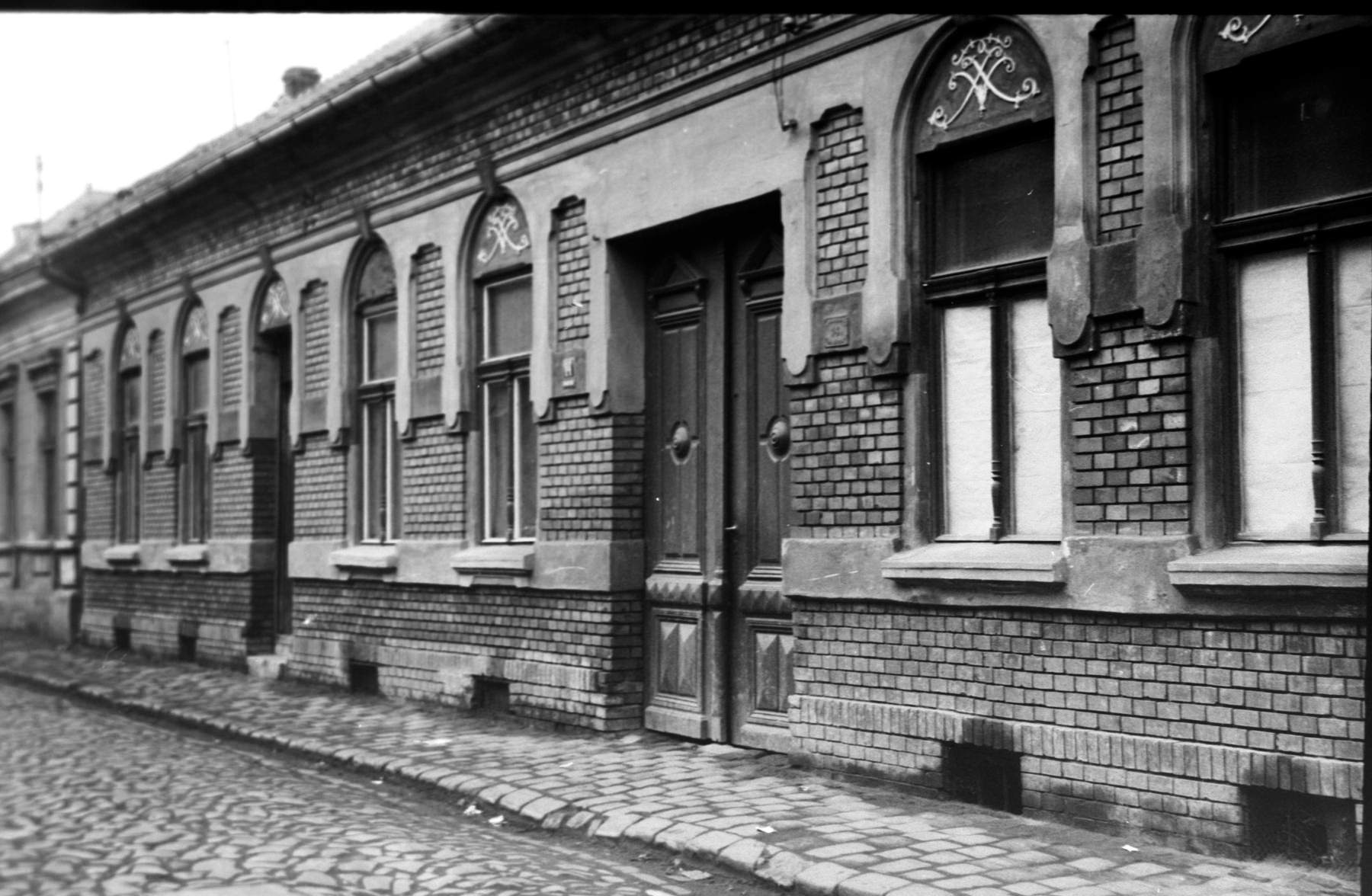
The printery, where we did practice work (v. 19-XI-1971.). Must be that en route to the political [school] (I shot this series walking there for that conference that DC-99 held there) I decided to forego the main street and pass that way. The building is a veritable miracle, and no matter how hosting a printery may have hurt it, it was saved from ruin that much, someone was maintaining it. There are nicer buildings in the area which suffered much worse because of no stewardship. And this shot turned out quite well, what with the granite cubes pavement and cobblestones for sidewalk. Then someone had the bright idea to cover this façade brick with mortar and paint it... fuchsia or hibiscus like, which looked great but didn't hold for long. Today, amazingly, all this ornamentation is still in one piece, but the mortar mostly fell off, traces of paint visible in places, and no window with all glasses whole.
This entrance is not an entrance. I never saw it open. This front wing I never actually visited, whatever I had in the printery went on in the newer building back in the yard. The only entrance was the gate, and this ajnfor was perhaps converted into a warehouse for paper stock. Only in the coming years I'll gradually get to know the security folks logic that all exits should be closed except one, and that one should be under control. Though, Zmaj had three entrances, but all three were open to all except the main one, which was for staff only. So the intent wasn't clear.
From this series there were a few more shots, how I'm opening someone's stojadin, no idea whose, but that someone was in charge of bringing the projector, which we then hauled to the fourth floor into the political... see further down the february articles.
----
* we still call it that; when I had this shot onscreen she asked „is it where pride is now?“. v. house dictionary
** wrong, that one was Borba or Novosti
*** the guarantee tape, which would be woven to connect sheets of paper and then its ends sealed with wax and stamp, for important documents
Mentions: 10-V-1970., 19-XI-1971., 25. maj, burundi, Čelik, DC-99, fića, hats, house dictionary, Lesnina, novogradnja, Presprom, Prleski, regula, Šanta, škodilak, tristać, vodotoranj, Zmaj, Žitni, in serbian
8-VIII-2024 - 12-VIII-2026