04-X-1988.
One of the trips to Gorizia from Nova Gorica. This time I'd pocket my passport and take a local bus to the real crossing (i.e. not one of the other four walk-in crossings for locals only), walk over the border, buy two kilos of coffee and walk back. The bus would still be waiting. This time did that four days in a row. Came home on friday with 8kg of coffee. I'd say this was the time when I took the long train back, which arrived late in the night... don't really remember how, but somehow I ended up in the saturday morning at the beginning of my street, don't quittte remember how. Possibly this was the time when also Radoja and the two guys from textile, whom we called Mirko and Slavko (as per partisan comic about two kid couriers, very popular in the sixties), so one of them had a father-in-law in Rakovica and that's where he left his lada. We took a cab and had to endure the cabbie, trying to be apropos, sold us a bosnian joke as if it were a Lala joke, with disgustingly bad imitation of the accent, the illiterate fool. Radoja said „that's what you get, you spend five days among programmers and you forget whom you're dealing with daily, so here's a sample for you“. Had to have a coffee with his old man, and somehow managed to get out of the clutches of his hospitality and drive home. They left me along the way, I'd say at Lesnina, so I walked the rest of the way. At the corner of 25. maj, I buught the newspaper (it being early enough in the morning so dad wouldn't be out to buy them yet) at the kiosk. Bought also the škija from Zadar, a whole kilo, not knowing that it was the last time I saw it.
From the other end of the street, the gates of šećerana, the long wave of protesters, participants in the so-called yogurt-revolution, marched to town. I didn't quite realize that this is the beginning of the end. Not of us personally, nor as a family, but the end of a country.
At that time, still, everything looked like a storm in a teacup.
I didn't just have done the solitaire on the atarist, I played with various other things, mostly in GfA Basic (written by some german outfit). Given that I didn't have a disk for it, only the 720K floppies, I couldn't do anything bigger at the time - the app I'd use would have to fit the floppy, and I may switch the floppy to save/load stuff to/from another, but that was it.
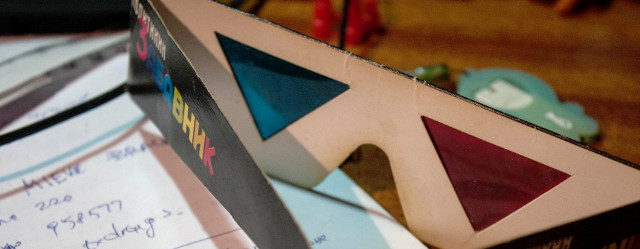
This time I remembered that descriptive geometry book (see 01-IX-1973.) and decided to do that myself. I had the green/orange glasses (just cardboard cutout with colored plastic, from Zabavnik, one of the 4-5 issues when they printed 3D comics in the middle pages) and just had to try to render something in 3D on the atarist.
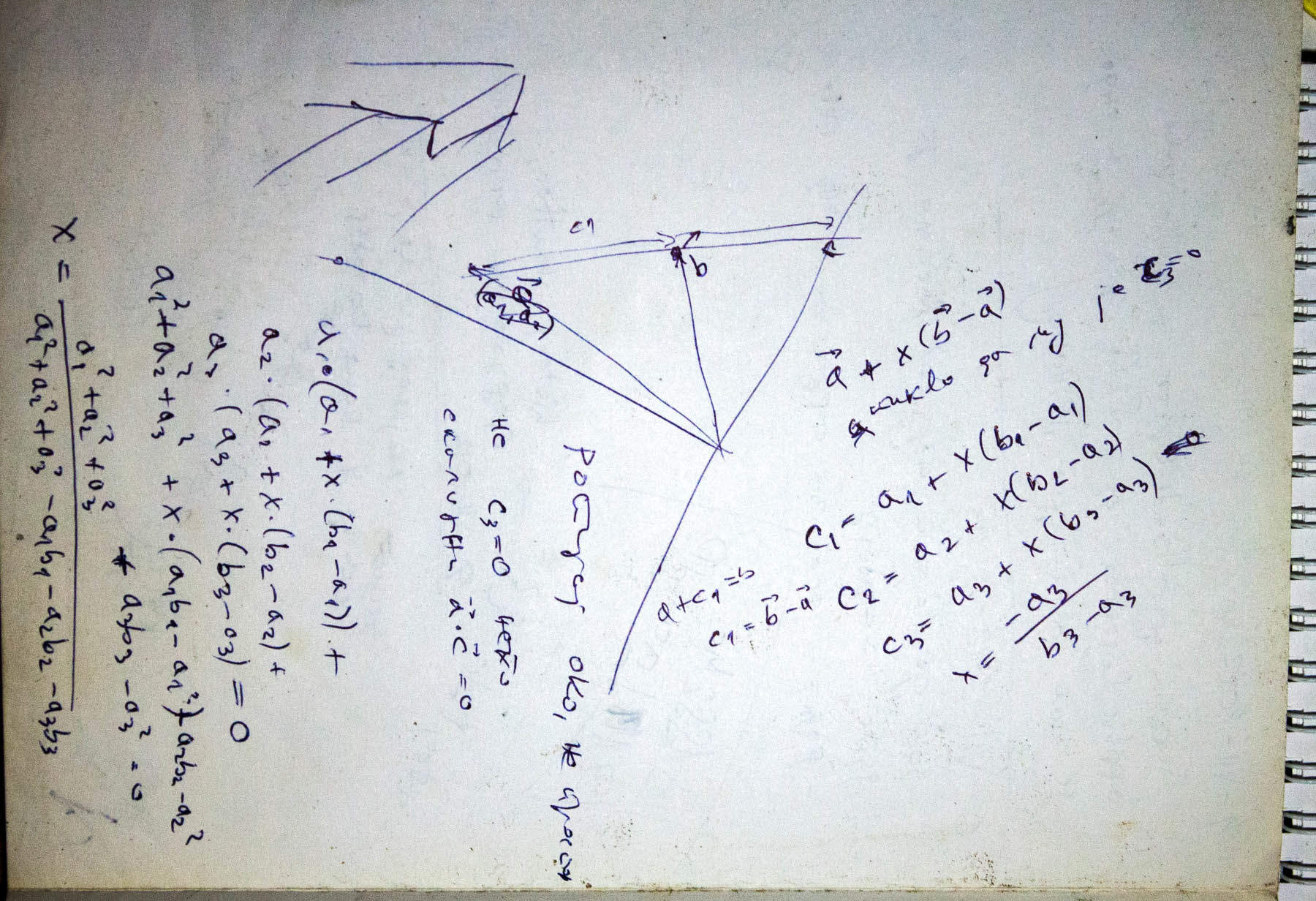
The piece of paper is where I developed the equations to calculate a central projection, as observed from an arbitrary point, projected to a plane perpendicular to the viewer's optical axis. The actual viewpoints would be somewhat to the left and to the right of it; the distance between them would be variable, and the whole view could be rotated around a vertical or horizontal axis (i.e. around a line perpendicular to the line between the viewpoints, or parallel to it, lying in the projection plane). I'd actually only move the viewpoints and recalculate everything. Moving the viewpoints was the only time when I had to employ trigonometry.
Instead of dealing with this or that set of coordinates, angles and whatnot, I decided to do this in pure vector geometry, which made the calculation much simpler (and hence faster at runtime). Only at the last step were the actual coordinates used to calculate the position of each line on the screen (of course, I'd calculate endpoints only, then draw a straight line between those dots on screen).
The first thing I did was to draw a simple cube, wireframe, not even bothering with visibility - everything was visible. And it worked, and was fast enough to observe motion when the system was rotated, One of the trips to Gorizia from Nova Gorica. This time I'd take a local bus to the real crossing (i.e. not one of the other four walk-in crossings for locals only), walk over the border, buy two kilos of coffee and walk back. The bus would still be waiting. This time did that four days in a row. Came home on friday with 8kg of coffee. I'd say this was the time when I took the long train back, which ran overnight... don't really remember how, but somehow I ended up in the saturday morning at the beginning of my street, buying newspaper (it being early enough in the morning so dad wouldn't be out to buy them yet) at the kiosk. Bought also the škija from Zadar, a whole kilo, not knowing that it was the last time I saw it.
From the other end of the street, the gates of šećerana, the long wave of protesters, participants in the so-called yogurt-revolution, marched to town. I didn't quite realize that this is the beginning of the end. Not of us personally, nor as a family, but the end of a country.
At that time, still, everything looked like a storm in a teacup.
I didn't just have done the solitaire on the atarist, I played with various other things, mostly in GfA Basic (written by some german outfit). Given that I didn't have a disk for it, only the 720K floppies, I couldn't do anything bigger at the time - the app I'd use would have to fit the floppy, and I may switch the floppy to save/load stuff to/from another, but that was it.
This time I remembered that descriptive geometry book (see 01-IX-1973.) and decided to do that myself. I had the green/orange glasses (just cardboard cutout with colored plastic, from Zabavnik, one of the 4-5 issues when they printed 3D comics in the middle pages) and just had to try to render something in 3D on the atarist.
The piece of paper is where I developed the equations to calculate a central projection, as observed from an arbitrary point, projected to a plane perpendicular to the viewer's optical axis. The actual viewpoints would be somewhat to the left and to the right of it; the distance between them would be variable, and the whole view could be rotated around a vertical or horizontal axis (i.e. around a line perpendicular to the line between the viewpoints, or parallel to it, lying in the projection plane). I'd actually only move the viewpoints and recalculate everything. Moving the viewpoints was the only time when I had to employ trigonometry.
Instead of dealing with this or that set of coordinates, angles and whatnot, I decided to do this in pure vector geometry, which made the calculation much simpler (and hence faster at runtime). Only at the last step were the actual coordinates used to calculate the position of each line on the screen (of course, I'd calculate endpoints only, then draw a straight line between those dots on screen).
The first thing I did was to draw a simple cube, wireframe, not even bothering with visibility - everything was visible. And it worked, and was fast enough to observe motion when the system was rotated, zoomed in or out.
I repeated this on a PC only after 2016 or so, though not with a cube but rather plotted a graph of a function of two variables. Did that before, but not 3d.
Mentions: 01-IX-1973., 25-II-2017., 28-IV-2025., 25. maj, atariST, lada, Lesnina, Radoje Maletin (Radoja), solitaire, šećerana, škija, yogurt, Zadar, in serbian
17-XII-2019 - 12-VIII-2026