stour
(Place, tavern, firm, Yugoslavia)
Just as oour was your basic organization of united labor (and the professor would fail you on your economy exam if you said "enterprise"), several of those could be united into a larger system, a SOUR (i.e. "složeni" - compound, or complex, oour).
Now STOUR has one more character - T for trgovinski, i.e. trade, commerce, wholesale & retail. My favorite take on it (which reached Žića during one of the occasions when we drank on the premises) was "složena i teška organizacija ugroženog rada" - complicated and heavy organization of endangered labor. Which it actually was, at least in the case of our "labor community of common services", as the central administration and IT department were called. Our labor wasn't on the market, we were servicing the actual members. We didn't get to decide about anything much, we were decided upon by workers' boards of the members and the central workers' council (of which I was a member, near the end).
We once did the stock analysis. Simple as beans - deduce the interest which would be paid for that value for the time a good sits on shelf. If you have 50 kilos of something at 30,00/kg sitting gor two months, that's 1500,00 * interest rate / 100*2/12, and there you go. We ran this analysis for two member firms - Čelik and Presprom. In one we got a light tap on our shoulders and saw a good layer of dust on the report a couple of months later. In the other they nearly kissed us (and both Radoja and wear beards), and they discovered that they have a smallish cistern of acetone, of which there was shortage, and sold it dearly (actually traded for another, even scarcer item).
Morale of the story: a dozen years later, both firms went bust.
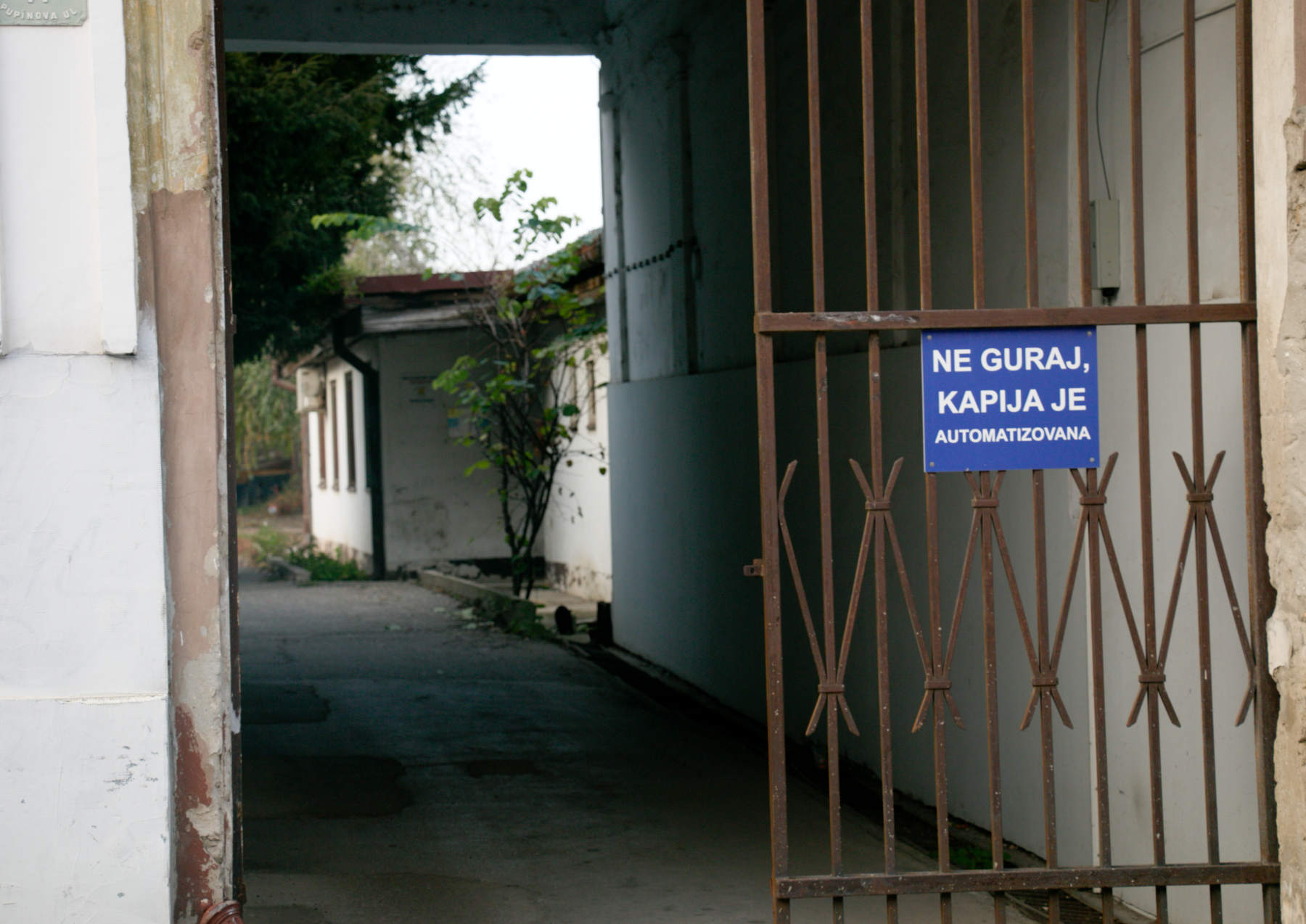
This is the entrance to the erc - the Vaha was in the house to the right, and internal bank in the lower house in the rear. The offices of directors, the coffee kitchen and Radoja were in the narrower part in the middle. I parked my bike by the door in the corner, behind the slim tree. Of course, back then the gate was not automated, it actually never was closed.
About RZZS, labor and market... we couldn't go out to the market, as erc, because Žića - nobody gets rich on my watch. The salaries in the RZ had to be equal, in average, to the average salaries in the whole system. Except the educational composition wasn't equal - with the exception of one and a half of a cleaning lady (Zlata, the coffee cook, and one we shared with the internal bank), and ms K.'s worker, and perhaps a couple more guys in the central office around Žića, most of us had college degrees. Among that, three were directors (he and the commerce and one irrelevant), three were bosses (Radoja, ms K. and the girl who was the chief of staff of the RZ itself), who had to have higher salaries by sheer position. I actually got some raise when I was appointed the admin (aka system manager, in Vaha parlance) and effectively inherited Iboja's position, but that wasn't much and other programmers had even less. And the average of that was not allowed to exceed the average of one NuProm or Čelik, where the average education was about half of high school, if that. Those had a lot of workers who learned on the job, maybe a shop manager had to have a high school, maybe not really. Of course we had a throughput, within a few months of my employment there we already had one farewell [party], then anohter. Fuckit, a real training center.
See 10-II-1989. for how that story ended, at least for me.
Mentions: A word from the author, july 1965., 26-V-1986., august 1986., 01-IX-1986., november 1986., 15-I-1987., 29-IV-1987., 22-V-1987., 02-VII-1987., 23-VIII-1987., 05-X-1987., 15-XI-1987., december 1987., february 1988., 19-IV-1988., may 1988., 24-V-1988., 29-XII-1988., january 1989., Interest calculus, 20-I-1989., Interest, as per bank, 10-II-1989., Plate gets hot, 01-IV-1989., june 1991., 19-IX-1991., april 1992., june 1992., 23-IX-1993., 15-IV-1994., 10-II-1999., 16-XI-1999., Hjuston, 09-I-2005., 18-VI-2013., 20-VIII-2014., 16-IX-2017., 20-XI-2021., Walnut, gone, 14-IX-2022., 26-V-2024., 07-VII-2024., Bogdan Levacki, Čelik, Dragana Vitas, DSS, erc, Gradivoj Sredljević, house dictionary, Iboja Vučetić, Joži Ramada, Marina Čikezin, MEC, NuProm, oour, Partner, Pavle Džeferdarević (Jolpaz), payroll, PDP, Presprom, Radoje Maletin (Radoja), Radovan Fišer (Mika Fišer), training center, triglav, VAX (Vaha), Vera Basta, virman, Žića, in serbian
4-IX-2019 - 9-IX-2026