january 1989.: Interest calculus
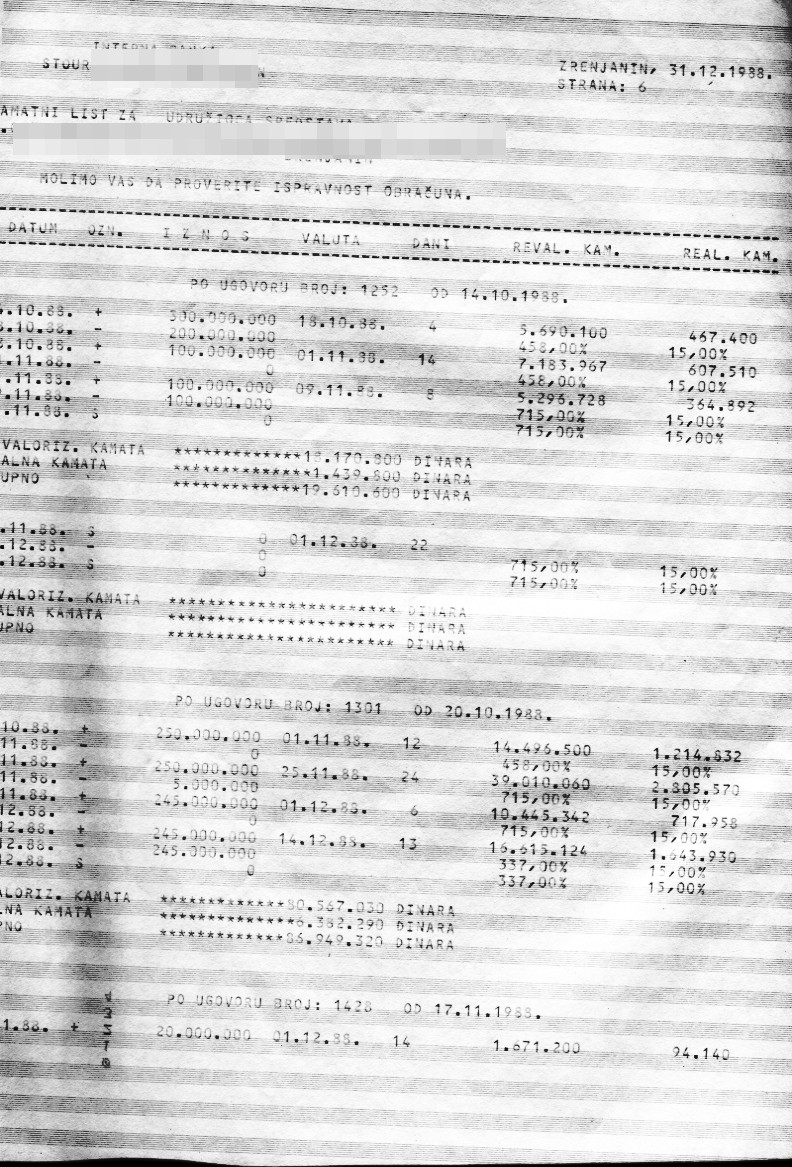
The investor here is some electro-construction OOUR, never heard of them.
The big printout of interest sheets for the internal bank of the stour. These internal banks were a big thing these years, being small, nimble and quick, they passed money where needed and rotated the money whenever one needed it to circulate instead of just sitting and rotting, because the inflation was high pitched. There were weekend contracts, whereby you invest on friday and cash in on tuesday, and someone borrows on friday afternoon and pays out on wednesday. Each kombinat had one. They dealt mostly among the members of their own systems, but just as well with any others. They had little staff, between a dozen at most and down to five in our case. They had just two rooms at the other end of the hall.
The interest calculation became complicated as inflation went on rampage. The state allowed to add the so-called revaluation interest, which was the officially accepted inflation rate. On top of that went the contracted, so-called real interest.
The image is an example of how that looked. The percentage of officially recognized revaluation ("revalorizacija") went from 337% to 715% per annum, depending on month. The calculation was done on each change (i.e. whenever the total changed - debt, payment, change of rate). Now since the interest accumulated each time, some time in summer 1987 they introduced conform rates. The conform rates are the same old rates, just decreased to annull the effect of compound interest. So no matter how many times during the period the interest is added to the capital, in the end of the year it would be the exact same amount as if it was calculated the classic way but without compounding the interest. It's not that complicated, though, at least not for us programmers - you only need to know that "add 10%" actually means "multiply by 1,1". So if you're adding ten percent twice, it's actually multiplying with 1,1 twice, so you actually get it multiplied with 1,21, so it's 21% - because the second time the 10% applied to the amount as it got increased after the first time. This is what ordinary banker can't quite follow, or at least can up to that point, but when you start explaining that, to actually get the 20% in the end, you need to multiply not by 1,1 but rather with 1,0954451 to get it multiplied with 1,2. That's where the open fracture of the brain usually occurs.
This kind of explanation happened when these conform rates were introduced (roughly, september 87). There we were, in Radoja's office, which had a long table with eight seats and served also as a club, he, me, our internal bank's director, Bogdan and his internal bank's director, the two programmer guys from the bank, their finance director, and perhaps one guy from the metals' kombinat. We explained it to death, lengthwise and breadthwise. Ended up with us programmers agreeing over the formula to use (which isn't that complicated, really, but it has a fraction in the exponent somewhere) and to send each other a list of daily rates for an arbitrarily chosen interest rates just to check each other. The directors remained clueless, but we promised they'd have such lists for any rate they want - so if the rate is 432%, that's 0,098424314% for one day, 2,995259072% for 30 days etc (I rechecked this in fox's command window as I wrote this, just to make sure, applying the formula as I remember it). They had no choice but to shut up and trust us to know what we're doing. Two days later, Bogdan and I sent each other a few such lists, just to check. We agreed to six and a half significant digits. More than enough - ten years ago they flew to the Moon on just five digits.
Later it got a bit more complicated, but not much.
The trouble with working in cobol was that it doesn't have exponentiation. Actually has, but only to positive integer exponents. Forget about fractional ones. So I had to write a small routine in Vaha basic to do that (not pdp basic, we had no plans to do this for NuProm and/or textile guys), then I linked that into the executable which calculated the interest, and it hit the road with pedal to the metal. The bank was brimming with cash, just buzzed.
Of course, none of that extra cash flowed into the erc. We are the RZZS (radna zajednica zajedničkih službi - the working community of common services), where the average salary has to be the same as in the whole stour, because "nobody will get [unjustly] rich on my watch". The fuckup was in the composition of RZZS, it was Žića, two lower directors, Zlata the coffee cook, half a cleaning lady (the other half was on internal bank's payroll), the service of plan and analysis (mrs K and her younger worker, who was Žića's mistress), the RZZS boss and three operators and four programmers in the erc. Which means three directors, three bosses, two unqualified workers, four with high school, and us four or five programmers. And my position was somewhat elevated, being the admin, and still I wasn't anywhere near happy with my salary. Because stour's average was exactly that: divide the total money with number of workers, that's it, average like any other. But, but, but - the majority of workers in the system were just shop clerks, warehouse workers, kiosk dwellers and such, to the tune of two years of high school in the average. The RZZS, on the other hand, leveled out at about two years of college. On top of that, the RZZS had three managers and three bosses, who just had to be paid above the average, so to keep within the system's average, it went at the cost of the rest of us. So it was quite possible that anywhere else within the system I'd be paid perhaps twice as much, but fuck, so it was.
And we have nothing to steal. The only thing that ever greased our palms was the wasted paper, all those wrongly printed reports, those of dozens of kilograms that nobody ever came to pick; the prints which failed mechanically because the paper was too light (minimum 50g per square meter, 70 or heavier recommended) so it would crumple when exiting from the printer; or the steel character band would fly off or break; or two pieces of printing protocol had different opinion on when's a page break due, so one page would have 55 lines and the next one just 2 etc etc.
So we called the paper service, they came with their pickup and loaded all the paper. Two days later they came and said they weren't able to separate our paper from what they already had loaded, but their estimate was that our share is 70%. There the driver winked at me - he used to be a student of mine, yeah right, thanks. Wasn't any kind of big money, and we weren't clear as to what's its status. This paper was always just dumped, had no value, so this money had no reason to exist, it's in the air. So we decided to put it into the coffee kitty. We had free coffee for two and a half months. There's our profit.
Mentions: 23-IX-1993., Bogdan Levacki, erc, fox, kombinat, NuProm, PDP, Radoje Maletin (Radoja), stour, VAX (Vaha), Žića, in serbian
16-V-2021 - 25-VI-2026