27-XI-1978.
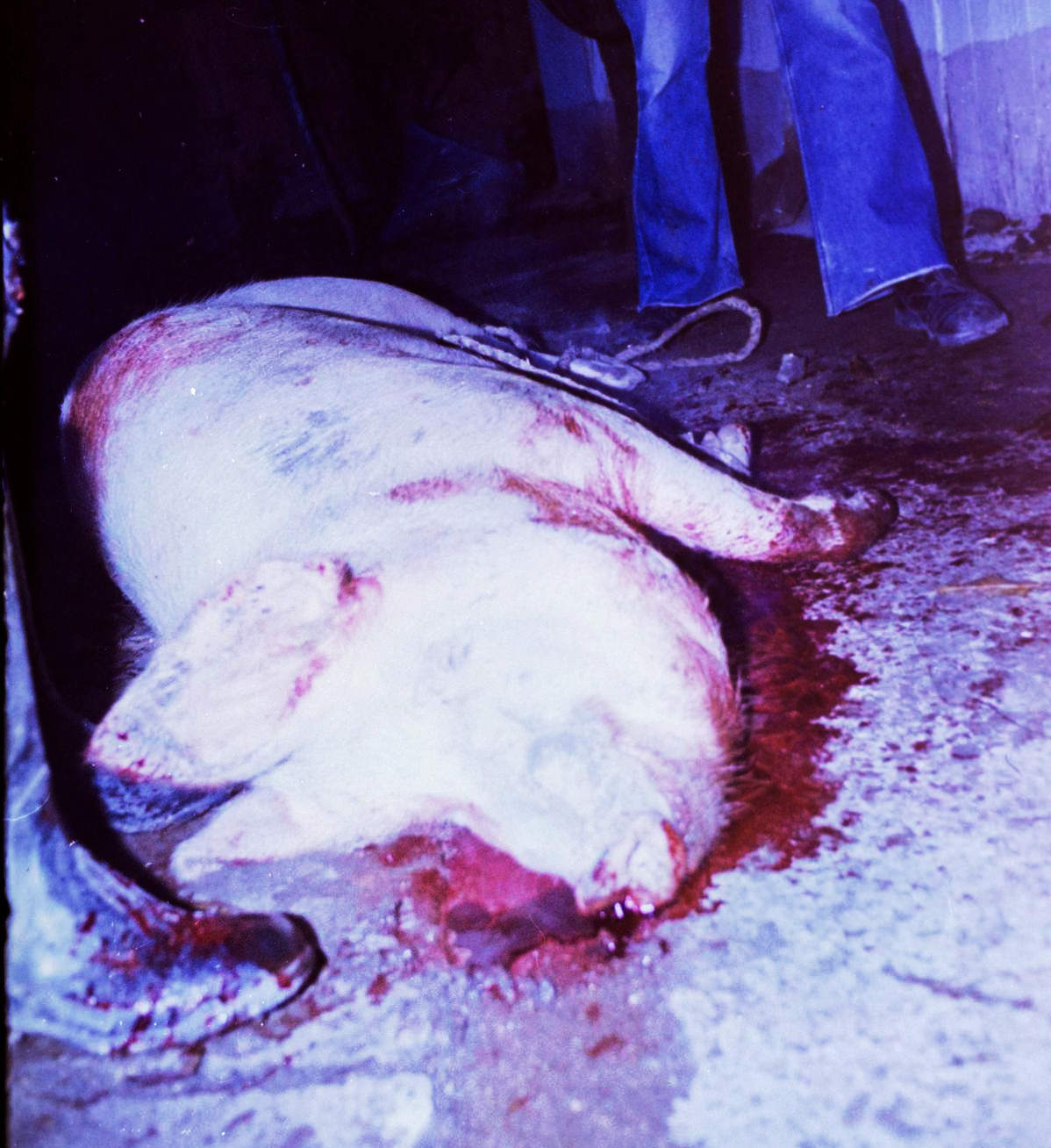
Two days ago, whole day at her place. Pigslaughter. I don't know whether this was the first time I had a role in that moba, probably not, as I had the forethought to bring praktika and to know the right time to sneak out, wash my hands quickly and come back to take a couple of shots with the main scene.
Eh, the happy times when the blue jeans were blue...
The schedule was, roughly, like this: I'd come at the crack of dawn, probably while it was still dark, and as soon as there was enough light to see what we're doing, the three of us (her dad, Arpi and I) would enter the pigpen, grab the hog - by its ears, feet - and drag it out. There on the path we'd tip it. Arpi would hold the fore legs, I'd sit on the ham and hold the lower hind leg with both hands, letting it do with the upper one whatever it wanted, thus making sure it can't find purchase as long as I'm holding it right. Her dad would then slaughter it, and Oma would lay a shallow pot to grab the blood.
It didn't go smoothly each time. Grabbing the hog, for one. It was done by a steel rope noose, where one end was welded to an iron pipe, and the other end went through the pipe and had a handle attached. This noose would catch the hog's upper jaw, tighten up, and drag the hog out of the pen and then, once in the open, we'd tip it. The trouble came the year when Oma did the big cleanup in her freezer and found some age old meat, with greasy parts (and grease changes taste when frozen, the chemistry doesn't stop, it just gets very much slowed down), which spent unknown number of years on the bottom. She fed those to the pigs, who not only gnawed it to the bone, they actually chewed the bones as well, and lost most of [their] teeth while at it. The noose had nothing to hold on to, it kept slipping. So the next thing to try was to grab it by the ear while in the pen, and hit it with the dull end of an axe on the brow, but that didn't work either, as Arpi missed and hit his own ankle, limped all day. That day was saved by the butcher neighbor who brought a pneumatic gun, just press it against the hog's brow, fire, and the needle pierces the skull.
Another time Arpi came with two pals, all three of them lastnighters. He was still good, he knew what awaited him and didn't lean as much on the booze, but these two most likely decided at the last moment to join him, even brought a bottle of loza along, and made a few blunders until the bottle was smashed. Then they rapidly sobered up and soon went to sleep it off.
When it would stop jerking, we'd drag it to the space between the house and garage (um... that was paved with concrete later, around 1982, or even later, so that image is from some later year... yup, on third shot it's on the path to the toilet behind the garage), where it would be surface burned first. That was usually done with handfuls of hay, or with boiling water, but nowadays any house had gas bottle and a brener (burner, in german - nobody really said plamenik, as would be the literary expression). Actually, on this weekend, ahead of sveti dvajzdeveti [saint twentyninth, i.e. Republic day, 29th november], walking down any street you'd hear the hum of burners from, like, every third yard. The winter marathon was afoot, one had to melt the čvarci, fill the guts with sausage, hang the hams to dry...
When the skin was almost black, water was poured over it to soften the charred tissue, which was then scraped off. The flatter parts with a shovel, crevices with a knife, what was left with a stiff scrubbing brush. Then the hog would be turned on its back and halved - one cut from the jowls to the tail, with the sternum being cut with axe and hammer. The guts would be taken out on the side. Usually there'd be two hogs on one day, they almost never had more, except maybe once, when we all concluded that it was too much, we barely finished it in a day. The halves would be then left to cool to ease the cutting, while we'd have breakfast, the black pudding of that blood, with onion and eggs, that Oma would make meanwhile.
After breakfast the table in the garage had meat cut on one side, and bacon separated from skin on the other. The bacon went into a bakrač (bakar is copper, such kettles were usually made of copper back in the day; now it was mostly cast iron), under which the brener was set, with a smaller flame this time. The brener would have even less flame later, because the gas in the bottle cooled as it evaporated, so it was usually put in a vat with hot water. Some brave fools even warmed the bottle with flame... On the corner of the table a spoon of salt was poured, so we'd dip the scraped skin in it and eat it as we went, that was the snack of the day. It was already roasted by the brener, so why not, just add salt.
By lunchtime all the bacon would be cut into cubes and the čvarci would be half ready, the hams would be carved „on round“, the other cuts already made - these for steaks, those for gulaš. A paprikaš would be made for lunch, and the guys would have a beer at that (not me, driving).
This was probably one of the years when tanti chimed in with some cash when the piglets were bought, so her share was one quarter. When the hams were tailored, someone asked, in the mixed language of the house, how to mark her ham. „Mah cvaj te“ (mach zwei T - make two T's). A dozen minutes later, Oma said „hab cvaj te gemaht, ver vilt“ (I made two teas, who wants?“).
Lots of smaller cuts, which couldn't be used elsewhere, went into sausage. The mix was kneaded in the tub where, on ordinary days, small laundry would be hand washed (for some reason it changed its name when it wasn't sheet metal anymore but became plastic). It held roughly thirty kilos of meat, which then took a kilo of minced garlic, some hundred grams of ground black pepper, and a kilo or two of salt, and then that was kneaded, kneaded... Oma and tanti would alread have washed the guts, having turned them inside out and scrubbed them with knives. The mix was then shoved into the piston for filling the sausages, syringe like but the 'needle' of about fi 25. The screwy part was the end of the gut, where a piece of string would have to be tied into a knot to prevent spillage. We all use fingernails to tie knots, which goes unnoticed until your nails are soft from being wet all day. Just try to tie a knot with soft nails. Also, all the door handles and floors were greasy and slippery, and given that we often had a knife in hand, we all had to take extra care.
In the end, when the lard is decanted and the čvarci taken out, the remaining parts would be boiled in that same bakrač - head, tongue, lungs, liver, tail, trotters - and those, still quite hot, would be deboned and minced into the mix for white sausage (i.e. liverwurst - do NOT confuse that with pašteta, this is a sausage) or hurka (pretty much like švargla, but with rice), which was all finished at some point in the evening. The sausages would be hung in the gangway, on rolling pins and broom handles strewn between the backs of the two armchairs, the hams would be dipped into salty water in that same tub, somewhere in the attic, the vessels and utensils were washed. We two would then probably go somewhere, as I had already taken the škodilak, which was mostly just in case we ran out of gas and needed replacement urgently.
When we finally developed this negative, Ljuba was already in vojska, somewhere in the mountains in Slovenia („it is a misconception that the balls can never catch rain“). I sent him the neighbor of this shot, assuming that he as a Sremac would have the eye for the beauty of the vista, and also to brag about our color process. Instead he thought I was mocking him, „here I eat what I eat and you send me this view from a hogslaughter“.
Today, a long afternoon in Dom, the new one. DC-99 was posting the exhibition. We got the big room in the front, which is all in glass walls, between the two entrances. They also supplied the panels, dark gray particle board on iron stands, sturdy neutral and quite OK, but they said we shouldn't use any tacks or pins. But that painter last week did use them when he had an exhibition. Ah, he had special french nails which don't leave a hole.
I still can't understand how someone bought that story. Well, we did what we could. We had to use selotejp (the 5cm wide transparent adhesive tape) but we looped them with the sticky part out, so they stuck to both the panels and the backsides of the photos. Don't remember whether this was her idea or mine. I remember Baja was there and maybe 5 or 6 others from the club. Still have a printed invitation, in gold ink, for the next day.
It was a rather big and important exhibition, the club was at its peak (one of) and we had participants from all over the country. It so happened that a famous photographer from Zagreb was serving vojska here in town, and he quickly made friends with the whole club and dropped by whenever he could, and so he was co-opted into the žiri. Win on all sides - we had a famous name listed, which boosted our rank; he got a chance to get out of the barracks longer than usual, and vojska scored points for cooperation with cultural institutions.
(now, in january of 2026, as I spotted the poster on a shot from the garage, I pasted a few surplus ones there, I see that this was actually a year ago, in 1977. oops. but it actually fits better, the builder's warranty was under conditions that there's no smoking in spaces where there's a carpet, and tiled and carpeted areas were so interspersed that it was near impossible to walk and smoke. Now given that I found that invitation, it's quite possible that we had another exhibition this year as well, but with the warranty lasting two years and the new Dom being opened in 1975, the above story applies to 1977)
Mentions: Arpad Gunaroši (Arpi), čvarci, DC-99, Dom omladine, Jablan Škanata (Baja), loza, Ljubivoje Tomić (Ljuba), moba, Oma, pašteta, praktika, škodilak, švargla, tanti, vojska, žiri, in serbian
9-V-2014 - 4-I-2026