june 1981.
In school there's less work now, as my class has graduate, I had four classes a week with them which now I don't. Filling in their diplomas and the main book took some hours, but fucket, had to do that anyway. The building became rather hot, as it's practically a glasshouse, the schools have to have a certain amount of windows, as per standards probably as old as the times of Amos Komenski. True, there's a line of trees up front, but they are tall and narrow, and the crowns begin at upper floors, the ground floors are a dušegupka*. We keep the windows open, and luckily there's not much noise, as the building is at the end of a cul-de-sac. Unfortunately, most of my classes happen in the rear building, in classrooms overlooking the yard, with the workshops below, so we not only get all the noises from metal work, but also their echo from the front building.
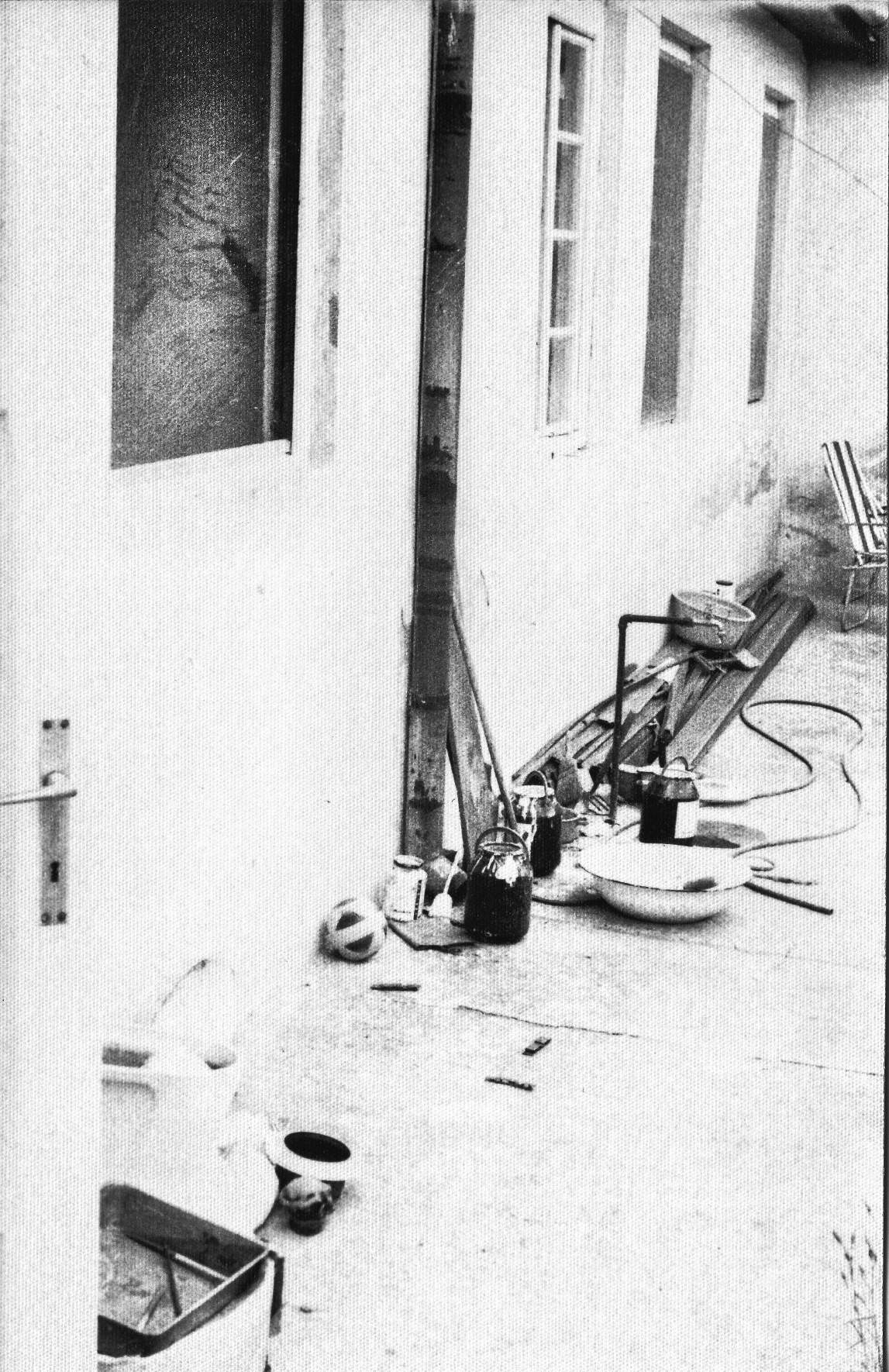
The big window was already set in place. I brought it on the bicycle, balancing it on a pedal, holding it with one hand and the handlebar with the other. Not even a whole kilometer, it's from the street leading the Čurda bridge. This means the little window, which was previously here, is now the bathroom window.
Judging by the moire in the window, we already put the mosquito net. We didn't make a frame, just nailed four slats to hold the net tight against the window frame. The net was, luckily, white, so it reflected some light, so the kitchen wasn't particularly dark. And it's facing northwest, getting some sun only in summer afternoons, the rest of the year it's shaded by neigbor's house.
The dark stripes in the corner are the plastic sheating, which we'll use to deck out the bathroom (anything behind the sink, crapper and shower) and kitchen (wall behind the kitchen cabinets and the fridge).
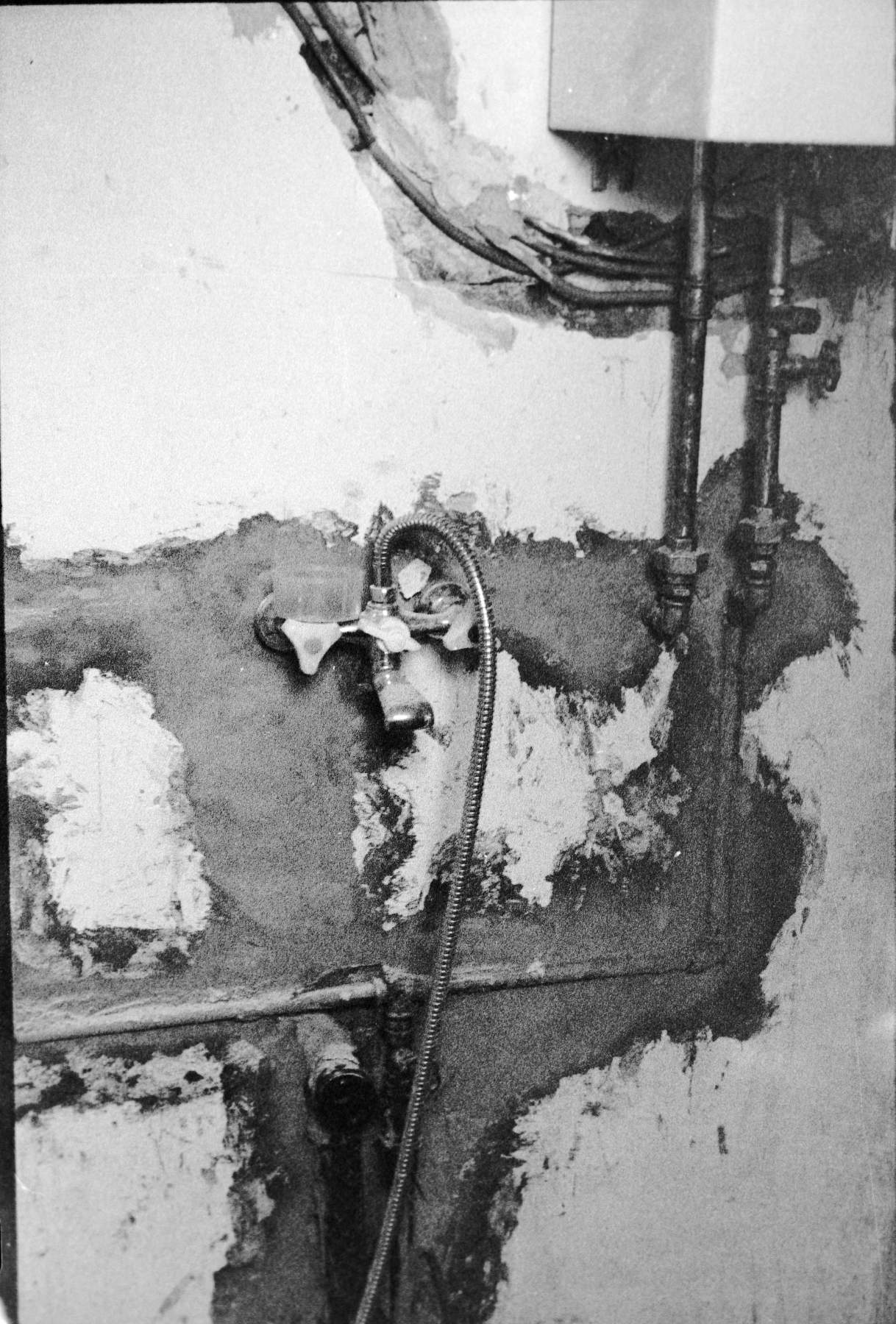
Doing the bathroom. For the pipes, her father came, he did that once already, so we routinely cut the thread into the ends of pipes, even for the water heater, for which it turned to be harder than it should. I took a 50 liter Končar, which had its intake pipes closer than regular. Not much, perhaps 15mm, but it took a lot of effort to get the incoming iron pipes in position.
But the first thing was to hang the heater on the wall. Regular, round heaters have braces in the back, which sit on two holders that you screw into the wall, using regular screws. This one hangs flat against the wall, is longer, narrower and square, and it's hung at only one point, above. It hangs on a single screw, but it has to be a 22mm, and to have a pad under its head on the other side of the wall, which is not a problem, just went and bought it. It's just one hole and the wall is only half brick wide, no big deal, just 15cm.
But no. That hole came out as the champion among obstacles. The brick was incredibly hard. Alternating the drill and chisel, Arpi and I, two or three afternoons at least. We were all smeared with sweat making rivulets over dust. We called this „atomic brick“, assuming it was what atomic shelters would be made from.
During the breaks Arpi would tell us how the Romanians escape. There are a few rigs (oil or gas) within spitting range of the border, so they got instructions from our border patrols to, if they hear shots, catch cover, best to go inside. Nobody will be shooting at them, it's the romanian border patrols shooting at their own [citizens] who try to escape, but a stray bullet can hit someone, better be sheltered. The best way, he said, was when a whole family would hide inside a combine [harvester] and then, at the best moment, just let the machine ride straight across the border to Yugoslavia. The patrol would shoot, the bullets would ping off the bulkheads... Then our patrols would catch the combine, stop it, pull out the folks, arrest them for illegal crossing of the border, take them to Padinska Skela, where they'd work the potato fields or something, for about a week. Then some international organization would move them to a refugee asylum where they'd wait a couple of weeks until some western country would accept them. Meanwhile ours would negotiate the handover of the combine with the romanian patrols, organize the process with proper paperwork and then it was done until the next batch.
It did happen that people died in the process, shot by their own.
The faucet is from Romania. Its handles are not the best plastic, but I estimated it would hold for a few years. It held for as long as we needed it. That was the trouble with romanian stuff, you never knew how long would they last. Usually the stupid things, those you'd soon start to dislike, would last years and years, and the things you liked would break or wear out.
The mirror above the basin was also romanian, in plastic frame, not too large, perhaps 15x20cm, enough to shave or comb. It would be tricky to hang on the hollow plastic sheating, so we glued it.
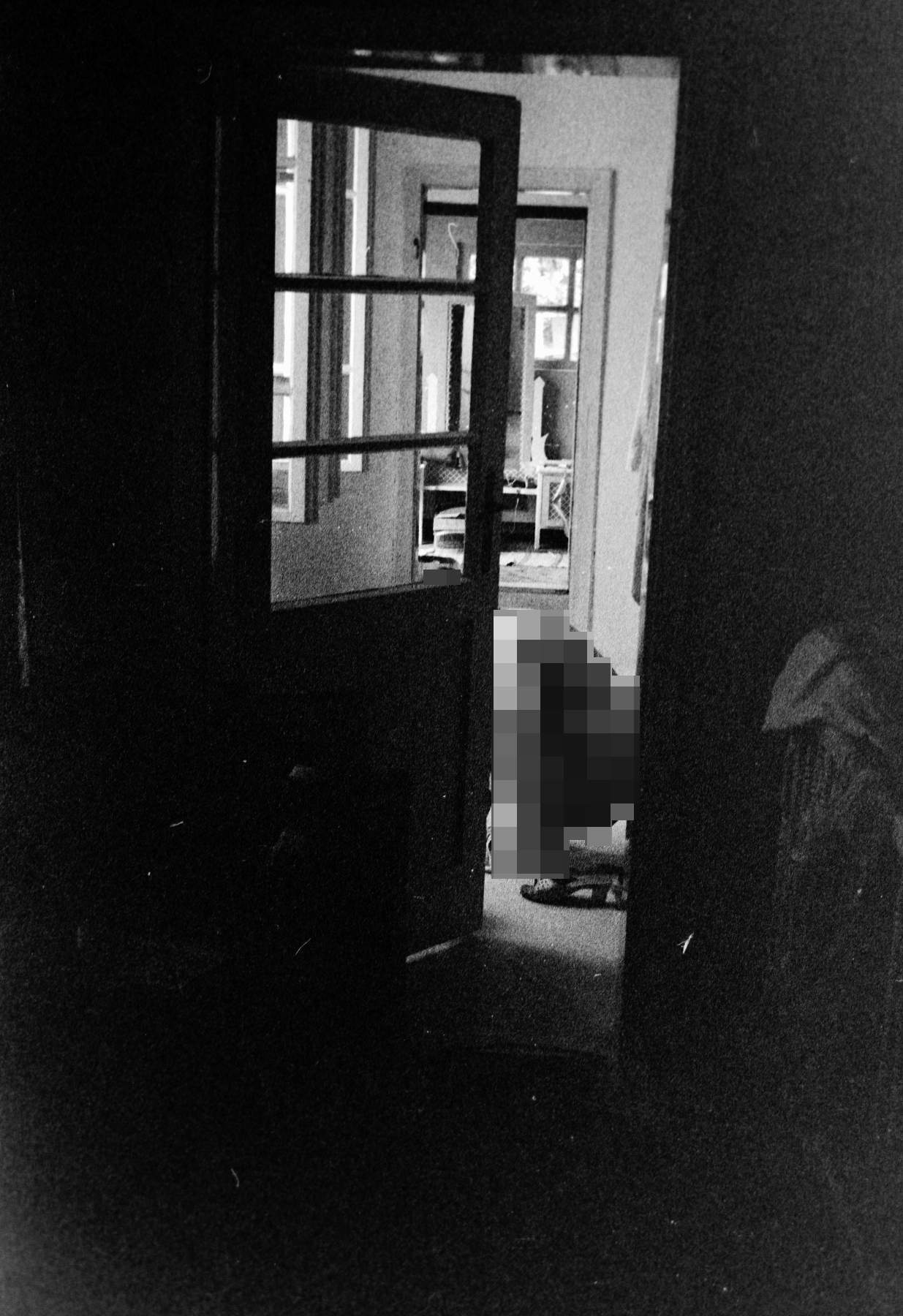
Glueing the vinaz tiles to the floor wasn't much easier. They need to be heated up, so they become pliable and fit snugly to the surface, they are brittle when cold. Having no precise heater, we used the old two bar area heater, of at least 2000 watts, if not 3000. The glue was some mildly thinned tar, and the excess glue would ooze between the tiles when pressed into place. We wiped it immediately with gazolin, which is what Arpi would gather at his job, at the aggregate station (not really an oil rig, but rather the local hub for several of them). It's a light oil, which emerges on top of the vat and has to be discarded. I've never seen a better solvent - one slight shake of the bottle, so the liquid would just touch the cloth on the bottle's top, would give it enough of it to wipe several smudges with just one swipe. The tar simply vanished, never was there.
The tiles in the bathroom came out uneven, and the crapper was always a bit shaky, because I didn't smooth the concrete precisely enough when I filled what I had to cut and dig when I laid down the sewer lines. Tuition...
(... 37 words...)
While we worked, all the doors were open. We slept in our previous room, with Go in her little bed, us on the old couch, while granma switched to the kitchen couch. Her old furniture was in the garage for the time being**, and the škodilak was in the yard. Once we finish this, we'll move our furniture into this new room, granma's to our old room (hers until 1963...) and we'll close this first door and cover it with a curtain. We didn't hang the tapestry on the door, but to the left of it. We'll do so only when we switch from the 6KW TA furnace to house gas, as the smoke pipe would come too close to it.
I had lots of trouble with wiring as well. The space originally had very few lines, just one lightbulb and one outlet per room, too sparse for a household. Which is why I led a thick cable from the fusebox by the gate, all the way through the attic, to its other end, which was at the end of this room - there was no roof over the kitchen and bathroom, just the concrete slab. Which we knew would be too thin, so for the next winter we insulated it with a layer of perlit. Which was an insulator, being hollow, but it was also hygroscopic, so it got really wet and our ceilings got dank and moldy. Had to remove that a couple of years later, and dad paid some majstors to extend the roof to the end. From the room I led the line to the kitchen and bathroom, and luckily there was a vent between the two, so I didn't have to drill a second hole. So I now had power supply for the kitchen, water heater, bathroom area heater, wahbasin and ceiling light and the washer.
I don't quite remember where I lead the threephase line for the TA furnace, which we also bought, so my girls will have the heating when the košava begins its song. The five-wire outlet I hid in the corner behind the door, and the appliance itself will go under the nearest window.
As I was in the workshop already, I also ran a phone line, connected in parallel to the existing line, and ended it with a regular phone outlet. True, we didn't have a phone, but will have. The only trouble will be that when anyone calls, both phones would ring, but that's a matter of convention. (when it happened, we simply picked up; if it wasn't for us, we'd dial a zero, and the other phone would ding ten times, which was signal enough).
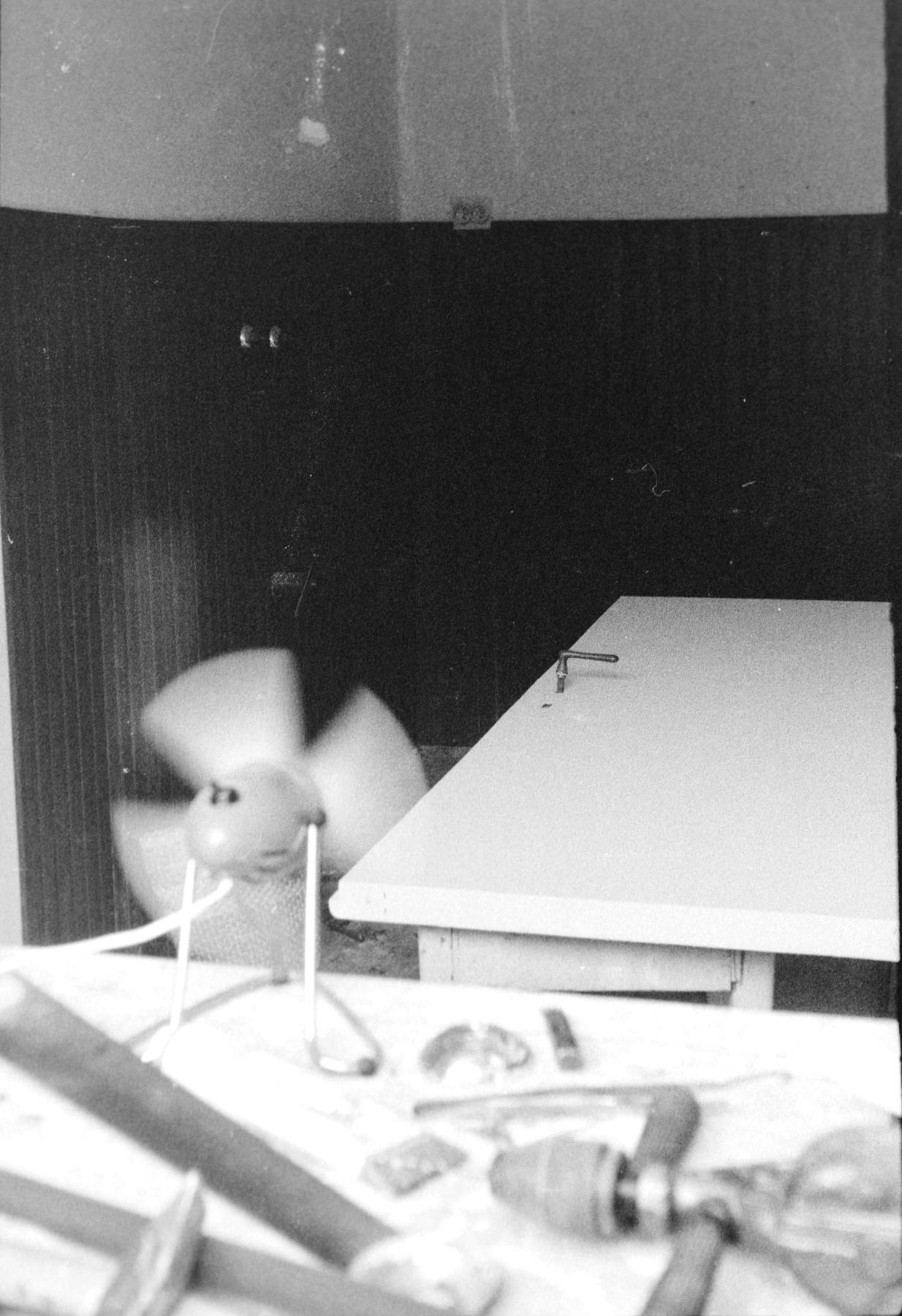
We painted the windows and doors. The panes we did in matte oil paint, white, pure white, because we equally hated how all the painters would dampen the white with a drop of black, making the whole world slightly grayish. The classical excuse was that then it's less visible when it gets dirty. Our retort was than it then looks dirty even when it's squeaky clean. This turned out looking right, just as we imagined it.
The fan on the picture is also romanian. The window and both doors are on one end of the kitchen, so there's no air circulation there, and the paint needs to dry. I see also the amerikaner, i.e. hand cranked drill, which we used for a dozen things. Every majstor worth his name simply had to have such an amerikaner, I kept seeing them in all the workshops since childhood, always that one and the same model. Most of the work was, however, done with the electric one. We borrowed both from her father.
Now for frames we wanted coffee brown, black coffee, but it would be tough to find such paint. The oil enamel came in a limited choice of colors and it was packaged in 1kg tin cans. It would have to be poured into a larger vessel to mix, but then if we mixed the whole amount at once, there's no way we could have used it in one day, it would have to stay mixed for several nights, and there it would get the crust on top, some thinner would evaporate etc. If we mixed only the daily amounts, there's no way we could hit the same shade twice.
There I got the idea to use polikolor instead, which is the simple acrylic paint. Having done a lot of color photography already, we knew the color theory, both adding and subtracting mixes... and simply bought red and green toners. Mixed them up and got exactly the tone we wanted, dark chocolate. The only trouble with polikolor is that it is not scratch resistant, as we witnessed around town, specially in old Dom. What about applying a lacquer on top of it? Well anything becomes yellowish under a lacquer, but then this already is so, no problem then. Then I remembered that there's a lacquer for boats - that's it, if it can take sitting in water, in a room it should last forever (presently over the 43 year mark, looks like new). The brand I found was slovenian, says „lak za čolne“. Whotever the čolna is. I mostly understand slovenian, but never heard of this. Doesn't matter, by the time we switched from window frames to door frames, we didn't lacquer them, we čolnired them.
Many years later it dawned on me that „čolne“ is not feminine, it's accusative plural of masculine noun čoln, which we say čun - a boat. So it was exactly what we were looking for.
----
* sounds like russian but isn't - duša=soul, gubiti=to lose, so this is where one loses soul, it being so hot and stuffy
** why the time being? There could be more time beings residing in the huge vastness of time.
Mentions: Arpad Gunaroši (Arpi), Čurda, Dom omladine, Gorana Sredljević (Go), house dictionary, košava, majstor, škodilak, TA furnace, in serbian
22-V-2023 - 25-VI-2026