sarma
(Translation, Yugoslavia)
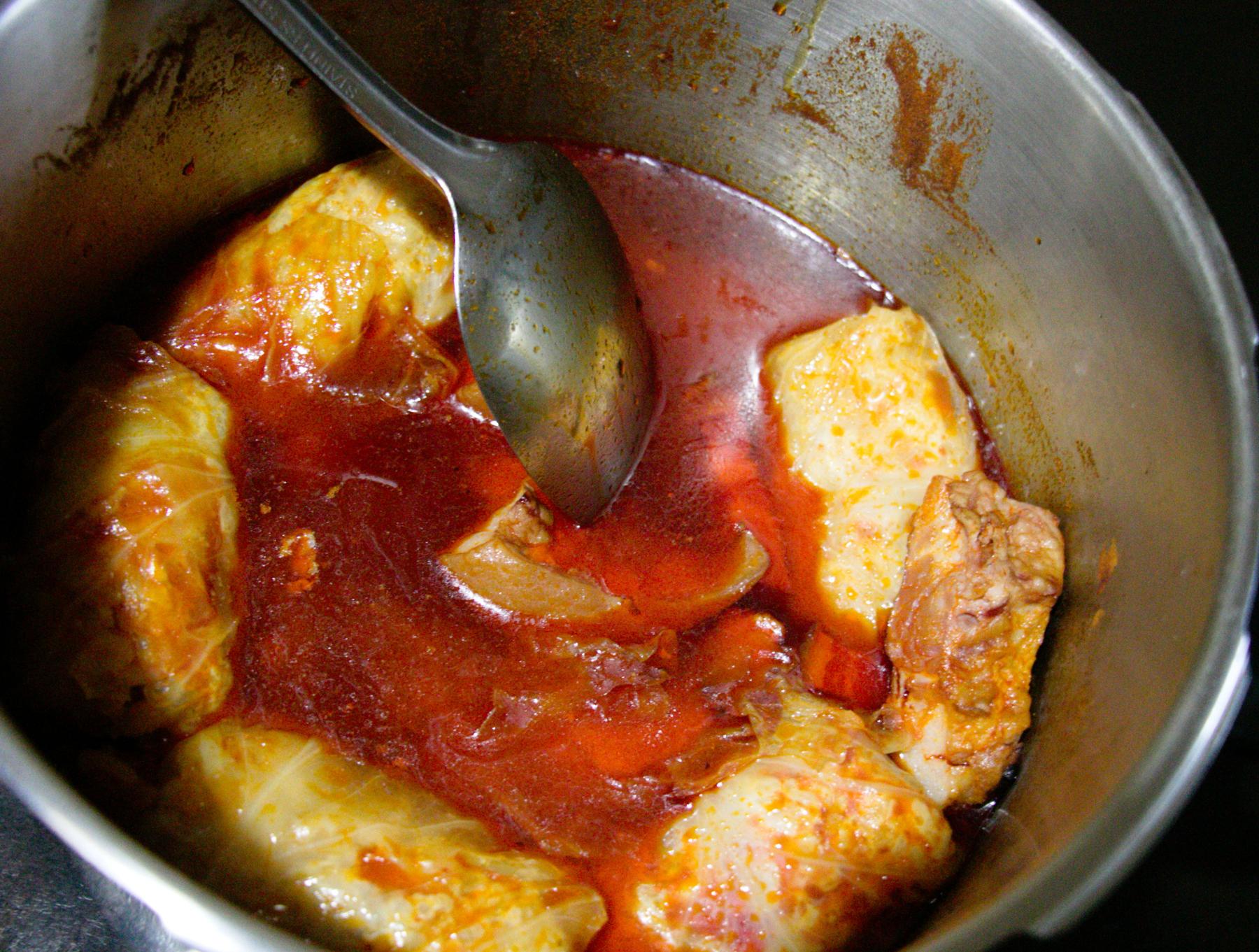

A dish of turkish origins. It's a mix of rice and ground meat with ground black pepper, rolled in a leaf of sour cabbage, taco style. Usually made in larger quantities, in a big pot, with zaprška, and eaten over a few days. Given the size of cabbage here (like a soccer ball, if not basketball), one sarma is food enough for one's lunch. One can find even larger cabbage - there's an urban legend that a whole train of Futog cabbage was returned from Slovenia, because the heads were too large, that can't be right. Futog is a special place, where the whole village grows cabbage, and heads of 30 cm in diameter are normal.
For ages the only proper way for a household was to make their own, which meant buying (or growing) your own cabbage, taking out the roots from the heads (which are called prokole when fermented whole, at the time when nobody ever heard the word broccoli, go figure), then filling the holes with salt. Once the heads were laid out in the barrel or vat, they'd shred te remaining heads into strips of, roughly 12mm or less, on a special cutter which was a board with two or three knives set at an angle of about 15° so the half-head sliding down the grooves in the board wouldn't hit it straight ahead, pretty much like a properly sized grater. The shredded would be tucked between the heads.
And that's where the recipes begin to differ - how much salt, how much water (if any - there should be enough of it in the leaves, and salted, they'll leak it), what time of year to do this (november is tradition, but anything else is also possible, albeit unorthodox), whether to put any spice (pepper grains are frequent, sometimes hot peppers but many consider that perverse, some add red beet for color. The salt water, rasol (salt-away, literally), is the best cure for hangover in the known universe and wider. It can be drunk, cold, as a refreshment, despite being a bit salty - it's close to the physiological solution in that area, so it's actually very pleasing. I usually drink what's left in the plate after sarme, and pleasant it is.
Another question, where schools differ, is the temperature of fermentation. Usually, if something goes wrong, it may stink, or stink temporarily and even out to the end, so people prefer to keep the vat in a back pantry, garage, on the terrace, anywhere outside of the heated rooms. Which then slows down the fermentation and it takes months (also does with too much salt, one neighbor put fivefold and had sour cabbage in april) instead of usual three to five weeks. My dad's favorite trick was to syphon out a few liters of rasol, warm it up on the stove, pour it back, repeat a few times. Just like any chemical process, it's faster when warmer.
There seems to be some fermentation still going on after it's cooked, because everyone (me included) says that sarma is the best the third day. The opinions differ on whether only the daily portion should be reheated or all of it. Recently I've heard that the proper heavenly taste comes only when it's reheated the ninth time on tenth day... Also, if you hear the expression "reheating the sarma" and there are two people involved, the most probable meaning is that they used to be lovers and may be trying to rekindle the old flames.
It's a matter of nostalgia among the expats and emigrees, so if you see someone in your country hauling twenty heads of cabbage in a cart, you can bet it's an ex-Yugo with serious intentions to cook a sarma.
Nowadays I just can't discuss sarme without mentioning Ender, who began with just a shy bite in 2009 or so, which he didn't like, to graduating in 2016 by explaining to us (!) that „sarma is not a need, it's a must“.
Mentions: 28-VIII-1967., 13-XII-1969., august 1971., 29-IX-1972., 01-XII-1972., 23-VIII-1974., april 1983., 09-VI-1984., Ten years reunion, november 1991., 15-I-2003., 15-IX-2004., 23-X-2004., 09-I-2009., 05-IV-2010., 13-IV-2010., 04-III-2012., 15-II-2013., 01-VIII-2013., 02-XII-2014., 02-IX-2015., 14-IX-2015., 04-I-2019., 06-X-2020., 27-XII-2020., 03-III-2021., 20-XI-2021., Walnut, gone, 17-X-2022., 11-I-2023., 08-VIII-2023., 05-X-2023., 19-XI-2023., 25-I-2024., 26-V-2024., 15-VII-2024., 11-VIII-2024., 21-X-2024., 14-XI-2024., 22-XI-2024., 20-I-2025., 22-II-2025., 05-III-2025., 21-VII-2025., 14-X-2025., 01-XI-2025., 29-XI-2025., 30-XII-2025., 12-I-2026., 20-I-2026., 15-II-2026., 25-II-2026., 10-III-2026., 21-IV-2026., 03-VIII-2026., Bosiljka Šain (Bosa), Ender Aquila (Ender), house dictionary, LML, plek, ppp, Skviki, Velemir Prokin (Čarga), zaprška
22-X-2013 - 8-VIII-2026