april 1985.: Pravilnik
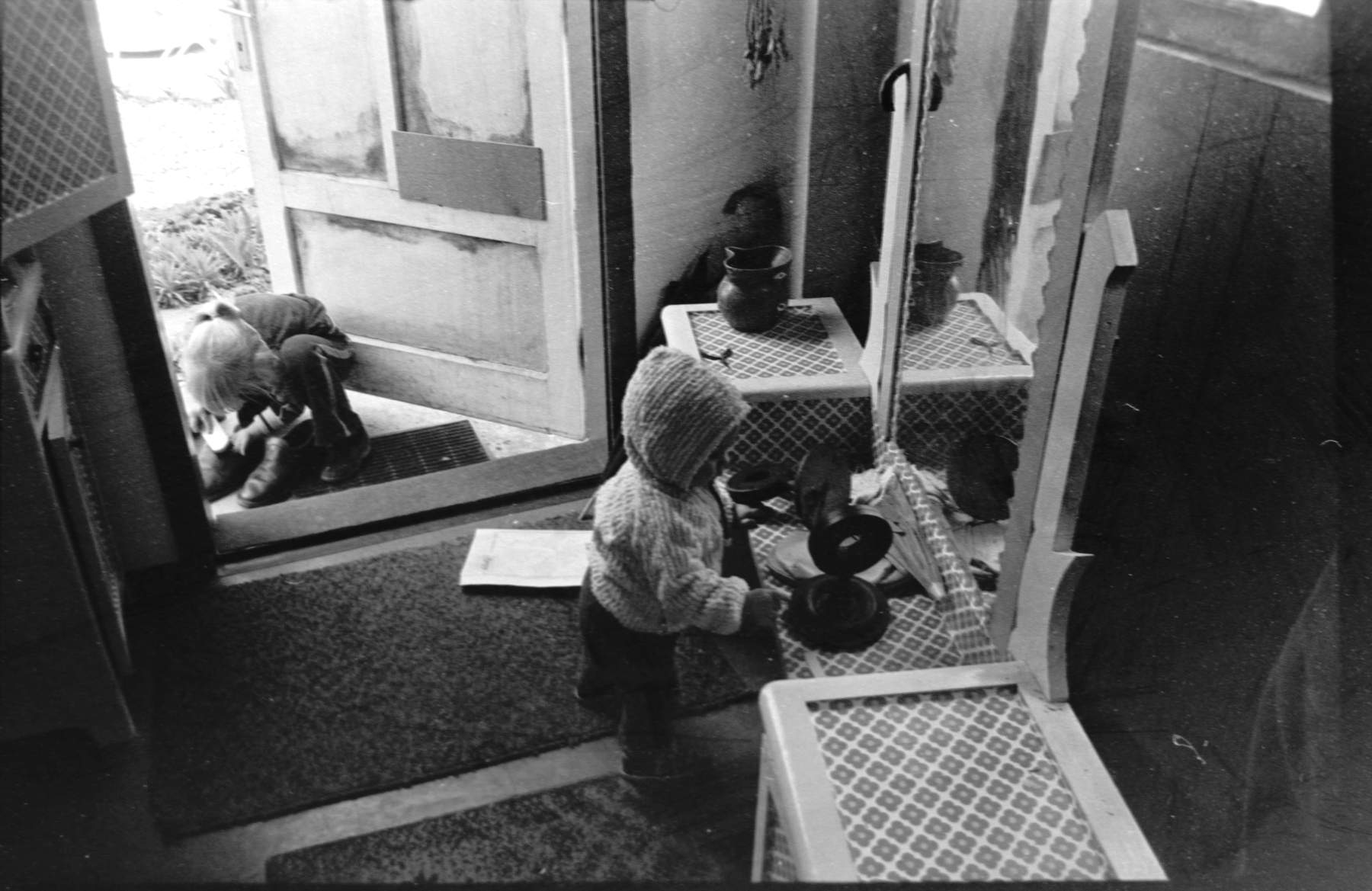
The girls in the anteroom. The door is obviously in bad shape, because it was already exposed, for for years in a row, to condensation of vapours from cooking and bathing from inside, and frost on the outside. The whole kitchen-anteroom-bathroom had thin, half-brick walls (12,5cm brick plus mortar), and was prone to condensation on walls and ceiling. It even happened at times that there was a whole centimeter of ice on the ceiling and upper walls on the inside. We heated up the bathroom only when needed, and the anteroom never, but the kitchen door opened frequently and all the humidity would find its way to the walls.
The door is as old as july 1959., when it was the front anteroom door. One of the following years I'll take it into my hands to soak it with base oil/resin in at least three layers, to make it firm and stop it from soaking more water. Then I'd cover it with plastic sheathing, same kind we used for kitchen and shower, just some lighter color. That will hold for another twenty years, when dad will finally replace it with a metal door.
All the furniture on this picure is antebellum, probably even before WWI.
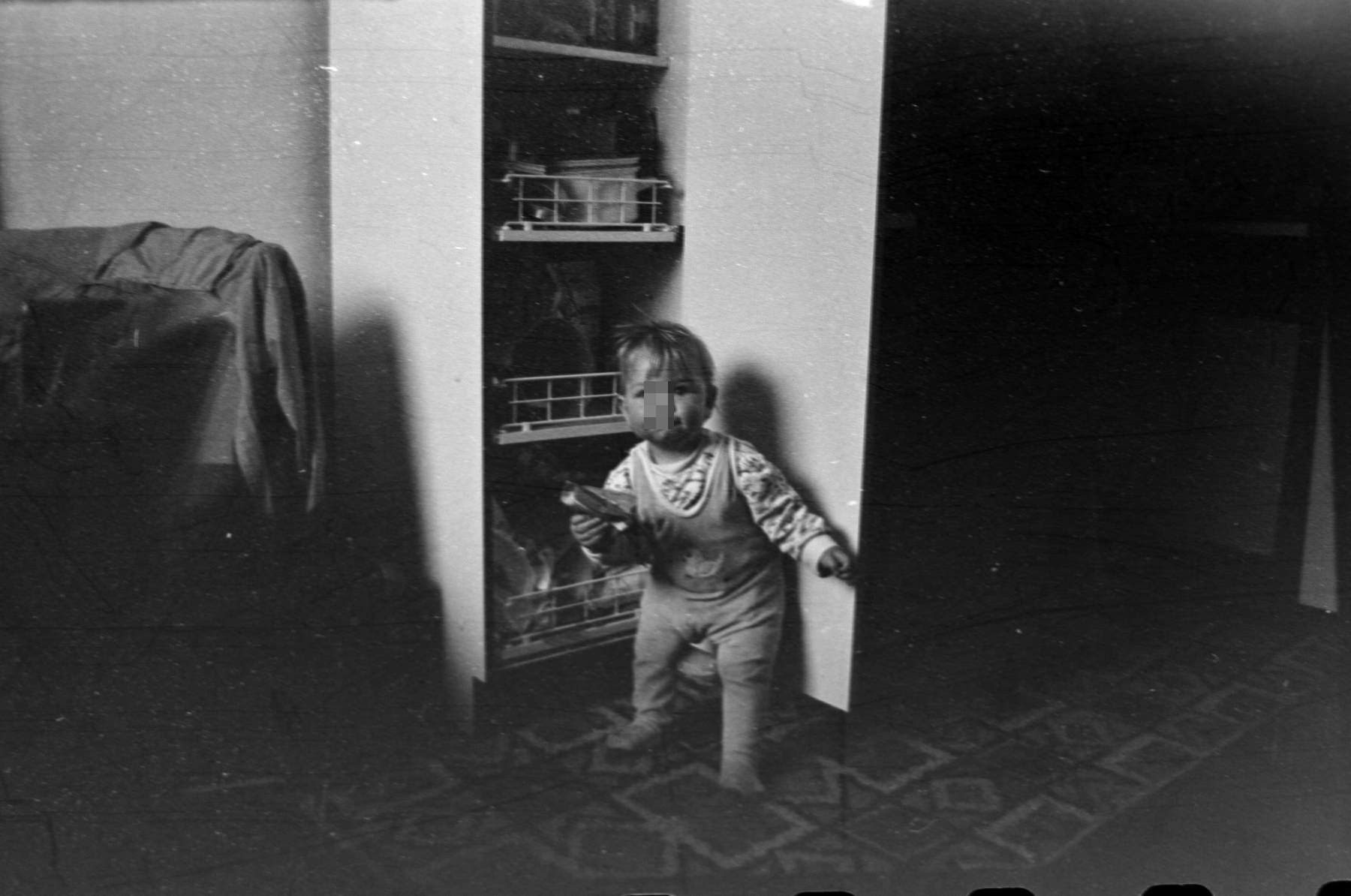
This photo is a legend - the poise, the look. Nina, just like any other curious child, has to rummage through the shelves.
The tapestry rug is Oma's work, I lay on it a lot while cramming for the last exams in the summer of 1979. It partially covers the potato pit, which is in the rear, to the fridge. The pit cover was made of wood, flush with the floor, and we neatly covered it with same vinaz (vinyl-asbest) tiles as around it. Still, some moisture condensed in the wood, and it gradually rotted. By early nineties we had to cover it with some plywood panel, which was just a tad bigger than the hole. It being covered by the rug made it easy to not notice when it shifted this way or that, and then a nudge in the wrong direction would make it cave in, along with whoever's leg was on top of it. Each one of us had at least one trip into the pit (which wasn't deep, 80cm), and that was also softened by the rug. Still, we had a place in the center of the kitchen where you had to watch your step.
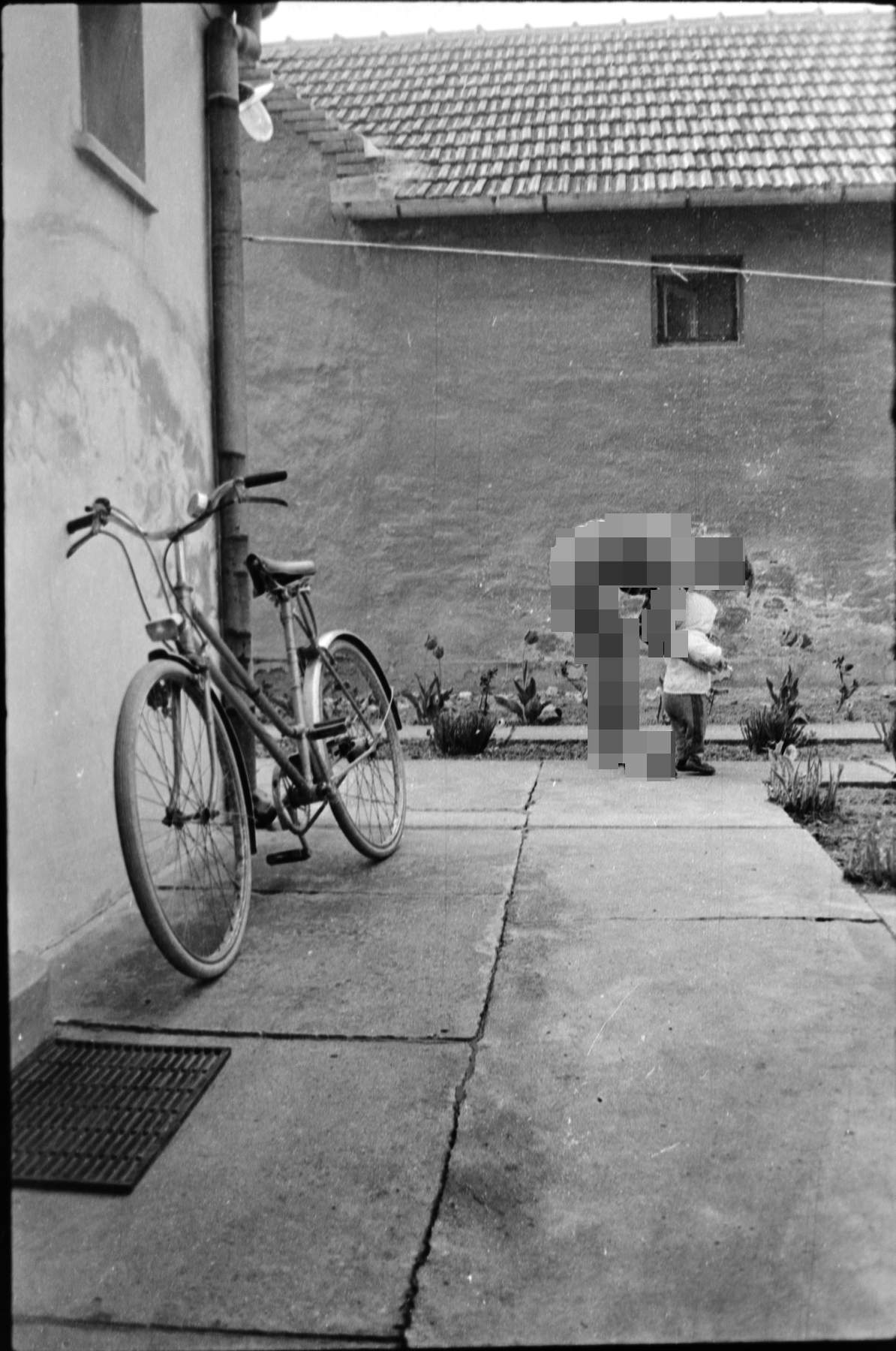
Her yellow bike, which we bought when we thought her old one was beyond repair. So it happened, only the opposite. At this time I was using this yellow one to commute, because its gearbox still worked. You couldn't shift gears, though, it had a Sturmey-Archer in-head gear switch, operated by a chain which you'd pull by the same sheathed steel cable as used for brakes; however it wouldn't move out of the second gear, but it at least ran. My black bike had the same type of gear shift, except the cable pulled the lever, which would then move the gears along the axle, which worked much longer than this (got that bike in 1978). However, the thin ring which was supposed to keep it sealed got bits of sand and salt in its seams, from too much driving through slush in winter, so it came loose and then more sand and salt got inside. The balls in the bearings decided to become other geometrical shapes - pyramids even.
The rubber doormat was smuggled from Romania. We have a few more, and they are all still in use, 35 years later.
In the mašinska they decided to have a new internal regulation on points, i.e. how salaries will be calculated. They put me into the committee tasked with writing it anew. To prevent pulling numbers out of thin air, I wrote a little app on zx spectrum, in Beta Basic, which did some kind of spreadsheet. That is, not a general practice spreadsheet, it didn't have arbitrary formulae, but rather a fixed formula, a scalar product of two arrays. One array would contain amounts of what a person does - how many hours, units of which kind of work, and the other would contain the points per unit - which was the array of numbers we needed to decide. These scalar products would be points total per person, then it would total those points for all rows (one row one person) and get the sum total of points for everybody. The amount of money for a month being known in advance (we played on last month's), dividing it by total points and then multiplying for each person in turn gave everyone's salary in dinars. A real what-if simulator, and I often ran it after each proposal was made.
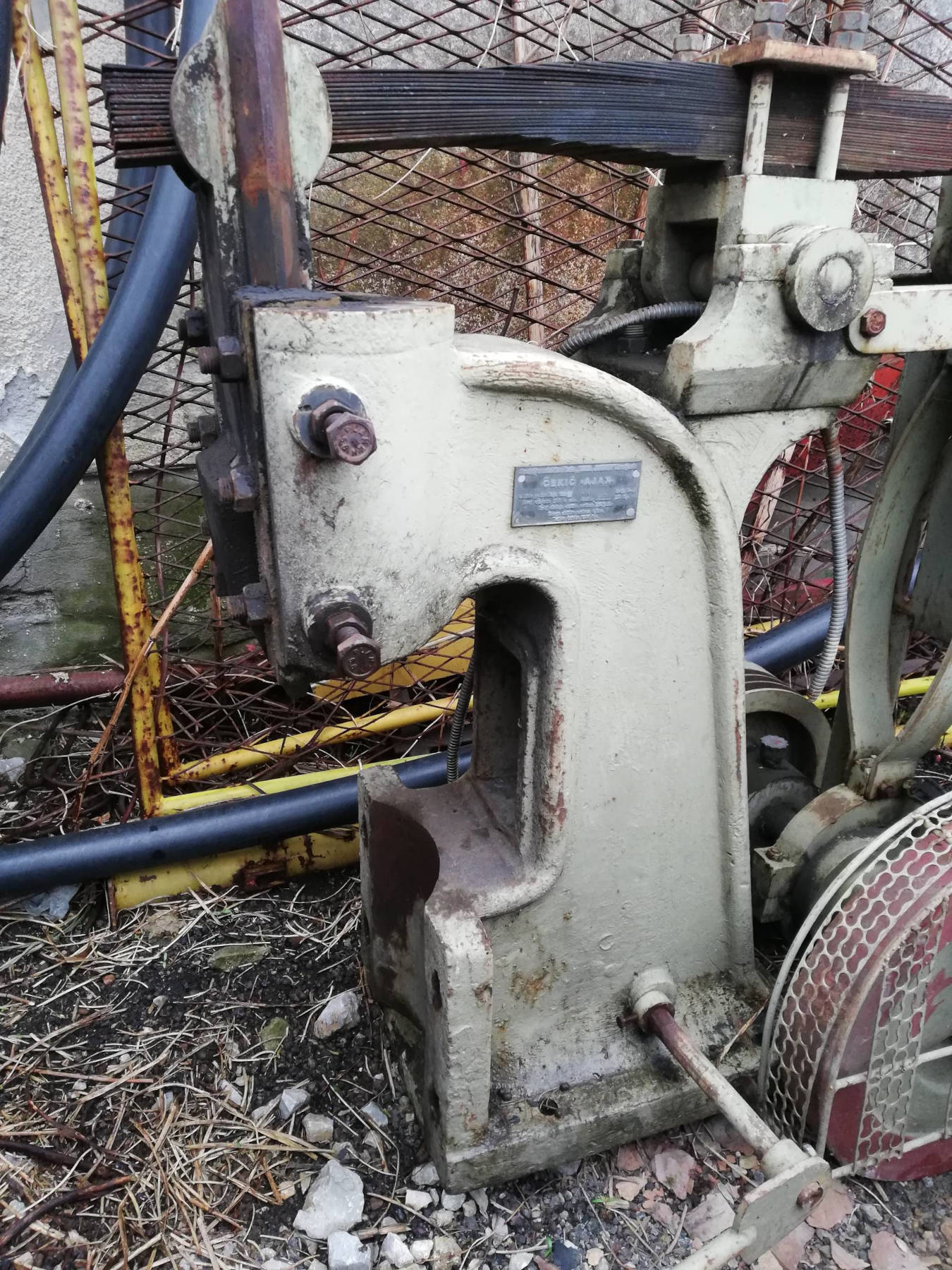
This is a ruin of one, found it in ads.
This is where I pushed through something for the workshop. They were making the so-called ajaks hammer, an electromechanical contraption which was basically a smith's hammer, just motor powered and spring-loaded. The hammer was more like a dull axe with flat edge. It would stop at exactly the set distance from the base, and that's what just about every agricultural machinery shop needed, to peen the ploughs and possibly other blades. Its main purpose in the school was to teach the kids to properly hold the metal file, as the spring was leafed and leaves were cut from sheet steel, so edges needed to be smoothed. They'd make about three of these every two years, and there was a waiting list, each one was sold long in advance.
My proposal was to split the profits from the workshop like this: 10% for the workshop itself; 10% for protection devices - gloves, goggles, aprons for the students; 80% into the common kitty. Which meant that for every dinar that the workshop pockets, the staff room gets eight. Miraculously, this was accepted. The results were visible immediately - the next year the production jumped from 1,5 to 19, and the workshop swam in money, and the staff's moustache was handsomely greased. Everyone had it great.
Except it wouldn't be. Few years later I dropped by, probably needed some piece of paperwork for something, and being already there and chatting with old pals, I asked how's the regulation going. Excelent, the guy said, we're smashing ourselves with money, and we're already making a new regulation to put it back to flatline. How so? Well, fuck the money, there are many professors who can't stand the workshop chief making more money than they. The small souls' vanity would have the whole zbornica have less, and lose that 8:1 ratio, just to right this wrong, period.
Anyways, that year the regulation was great, well accepted and even if they didn't carry me on their shoulders, at least Krle Vlajić, the director, understood that I pulled the cart, did the bear's brunt of the work, and invited me to his office. Someone else was there, the pedagogue or shift chief, don't quite remember. He said kudos to you, man, you did a great thing and I'm very sorry that we have no way to reward you for the work done, you're now exactly the expert on the matter, there's nothing in this regulation that we can use as base to pay you, it ties our hands (though, I didn't even think of being paid, it was interesting, I had a good solid problem to solve, it was fun). But, he said, we'll find a way not to stay in your debt.
And what it was? Few weeks later, same setup, Krle's office, one more guy in attendance (not the same one, I think), and he says I was a candidate to become a Party member. Oy oy. It's not healthy to refuse, and on the other hand I wasn't loathe to accept, we're all red inside, even knowing what kind of turds are in there, stop complaining and go inside and start putting things in order, do something. As they'd say in sixtyeight, my march through institutions.
They ran me through some courses the following weeks, which was basically a dozen of us, mostly younger than me, even couple of my students, listening to a talk in some salon, upper floor of some old building in the main street, quite full of old decadence in its air and setup, and then we'd discuss matters a bit afterwards. Took altogether six hours in three sessions. The lecturers were quite young and surprisingly open, and every time the theory they laid out clashed with the real life situation, they acknowledged it and said it's us who are expected to not like it, and to see to it that the things are put right, when we become members.
I don't really remember when I became a member, nor where my membership booklet ended up.
Mentions: july 1959., MPSŠC (mašinska), Nevena Sredljević (Nina), Oma, zbor, ZX Spectrum, in serbian
5-VI-2021 - 2-IX-2026