weddings
First, the ring. Here, traditionally worn on the ring finger of the right hand, contrary to the custom in the west. If you see anyone with a golden ring on the left hand, that's an engagement ring.
I have no clue why, but the word for the wedding ring here is burma. Yup, same as the country presently known as Myanmar.
Now what with many different customs being mixed up, with internal colonizations bringing customs of the area of origin, there was often a lot of hot air about which customs to follow in each case. Not only in the case when religions were mixed - there was mostly a consensus among the religion professionals, them all being thoroughly patriarchal, that the bride should convert and that everything should go as the male side's custom is, but in many other cases as well. There are all sorts of possible risky combinations - atheist with protestant, muslim with orthodox christian, and even both atheist or both orthodox but of different serbian brand. There may be any hothead who'd consider the marriage null if this or that custom was not observed, but then that thing is never done by the other side, and if the opponents got drunk before they settled on the ceremony, anything could happen. Such stories are now mostly forgotten, but I recall some injuries, ambulance being called.
Over the years (in the eighties, perhaps) cooler heads have prevailed, and the morning of the wedding (if not few days before) the parties, mostly parents of the couple, sit and agree on the ceremony, which customs to uphold and which not. The list of rites to perform has also gotten shorter, and also cheaper for the guests. Because, historically, the wedding party was mostly an investment, one good all-night party to get the young couple enough to live for at least a few months. And it's not just the presents given, it's that many such rites include some payment. One never forgets the eerie feeling that there'll be yet another way to gather some money as the party progresses, and what if I miscalculated...
Various customs include (and I've never seen more than four or five done at the same wedding)
- the rosemary (which was actually small money and it went to the girls)
- Mother's pogača (a pie-sized loaf of better bread), which was passed around, everyone'd take a pinch and pay for it with everyone looking, so don't be shy
- crossing the river (saw this only twice) - there'd be a low tub with water that everyone had to cross to get to the party, but the crossing was paid.
- loud reading of who brought what present; this could be anything from a dining set, crystal glasses, to a whole set of furniture
- dancing with the bride, not even a whole song, less than half a minute, paid
- selling the bride to the groom's family, mostly mock trade with prearranged and pretended dramatic turns, paid from his family to hers but actually going to the couple
- substituting fake brides at that, trying to sell an old woman or a bearded guy instead of the bride, done for fun
- when leaving the city hall, the kids would shout „kesa, kume“, originally „kume, izgore ti kesa“ (to kum, „your [money] bag is on fire“), to which then he throws away coins and the kids rush to pick them up. The kids aren't necessarily the guests' children.
- kum has the duty to be the life of the party, his is the first toast to the couple, he commands the band. Has some authority over everybody present, for fun, but then there are limits to that. The band may suffer from a drunk kum, there are many recounts of bands being forced to climb a tree or roof and to play from there. That's before they all went electric.
- the procession goes with as many cars as possible, first from the groom's house to pick the bride, then back to his house (a smaller party stays there once they leave, and they may stay until morning if so inclined, even though the main wedding is elsewhere), then to city hall (optionally church as well), then to the actual party, which may be at groom's place or at any restaurant that's large enough. Local hotel may have the capacity to take 200 people if needed. The first two cars carry the couple, kum, 2nd witness aka stari svat (old wedding-party-member); they are more decorated than the rest, though they all are, and are traditionally the best cars in the column, usually a mercedes borrowed from some gastarbajter. They often honk, all of them, all the way. Originally, only the couple were on a horse cart while the rest went on foot, then them on a cart and rest in cars, now all in cars - the distances having also grown.
- the couple's brothers, if any, are in charge of any mischief

The food served is mostly traditional - some gibanica or other salties as an appetiser, a soup or čorba, then roast meat (natur steak, barbecue, pohovano) or even gulaš, salad on the side. Then after a break there goes the wedding cake, which is supplanted with several lesser cakes, so everyone gets a slice, and generally they overdo this so about half of it remains and probably gets split among the family, not to go to waste.
As for drinks, traditionally it's only rakija until lunch, though many go for beer as well. Pelinkovac has also become popular again and many restaurants offer it along with rakija and vinjak. After lunch they mostly switch to wine or beer, though many opt for špricer, as that can be drunk for a long time.
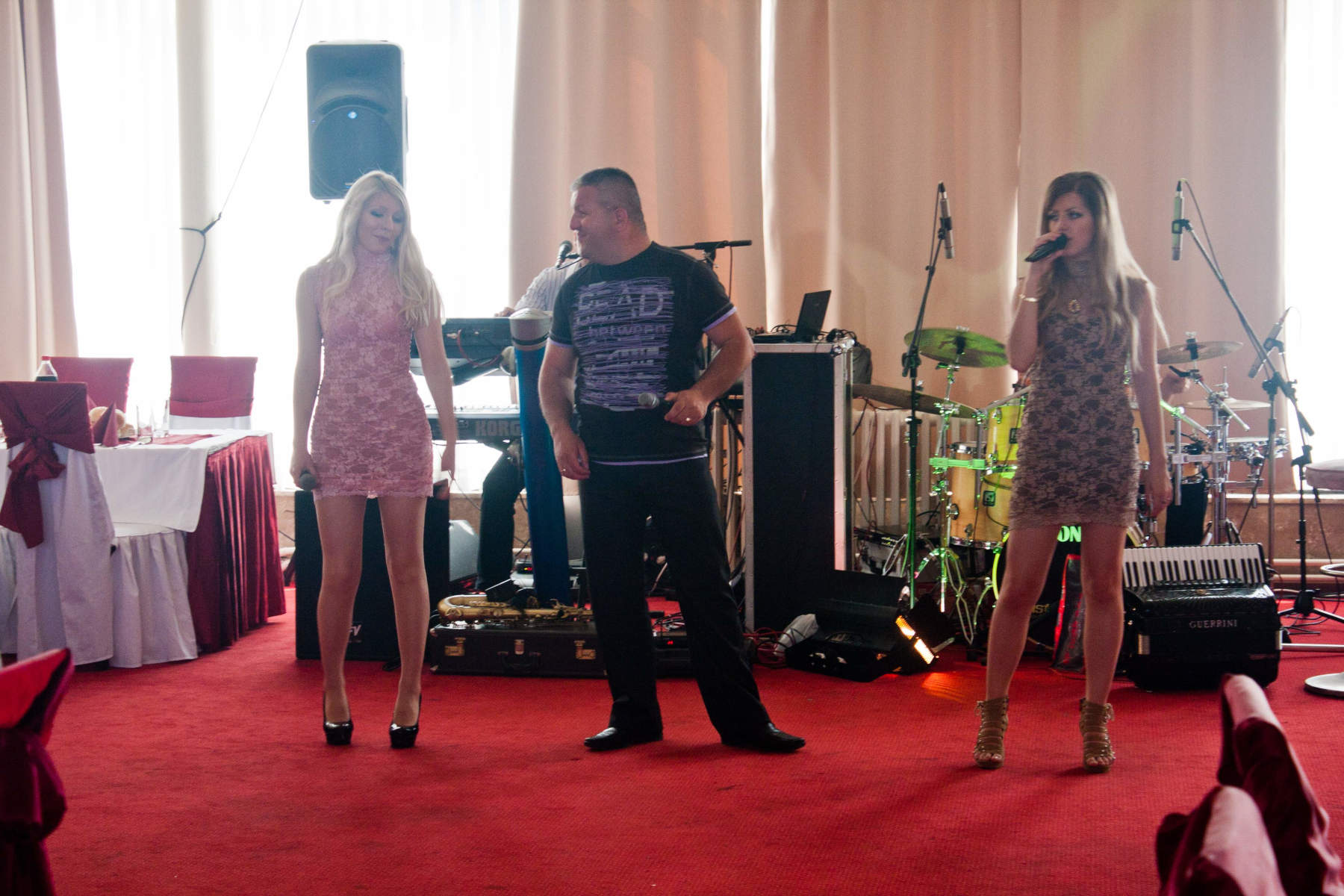
The party may last until any time of night, depending on the place (unlimited if at home, but mostly ends by dawn) and the arrangement with the band and the barkeep. Bands often get paid in bulk for the afternoon and evening, until, say, midnight, and after then it's the songs for the asking (and paying). The band is usually narodnjaci, but that's not a rule. The average band in the last two decades (though I haven't been to many weddings in that period and specially not among the very rich) is one guy with a battery of synthesizers and one or two singers, one of which must be female. They play everything (and in some cases, it doesn't matter what do they play, it all sounds the same).